HackRF One · Volume 1
HackRF One Volume 1 — Series Overview, the H2R4 Bundle, and the Upgrade Landscape
An engineer's tour of the HackRF One, the PortaPack, and where the Pro fits, with depth indices into Volumes 2–12
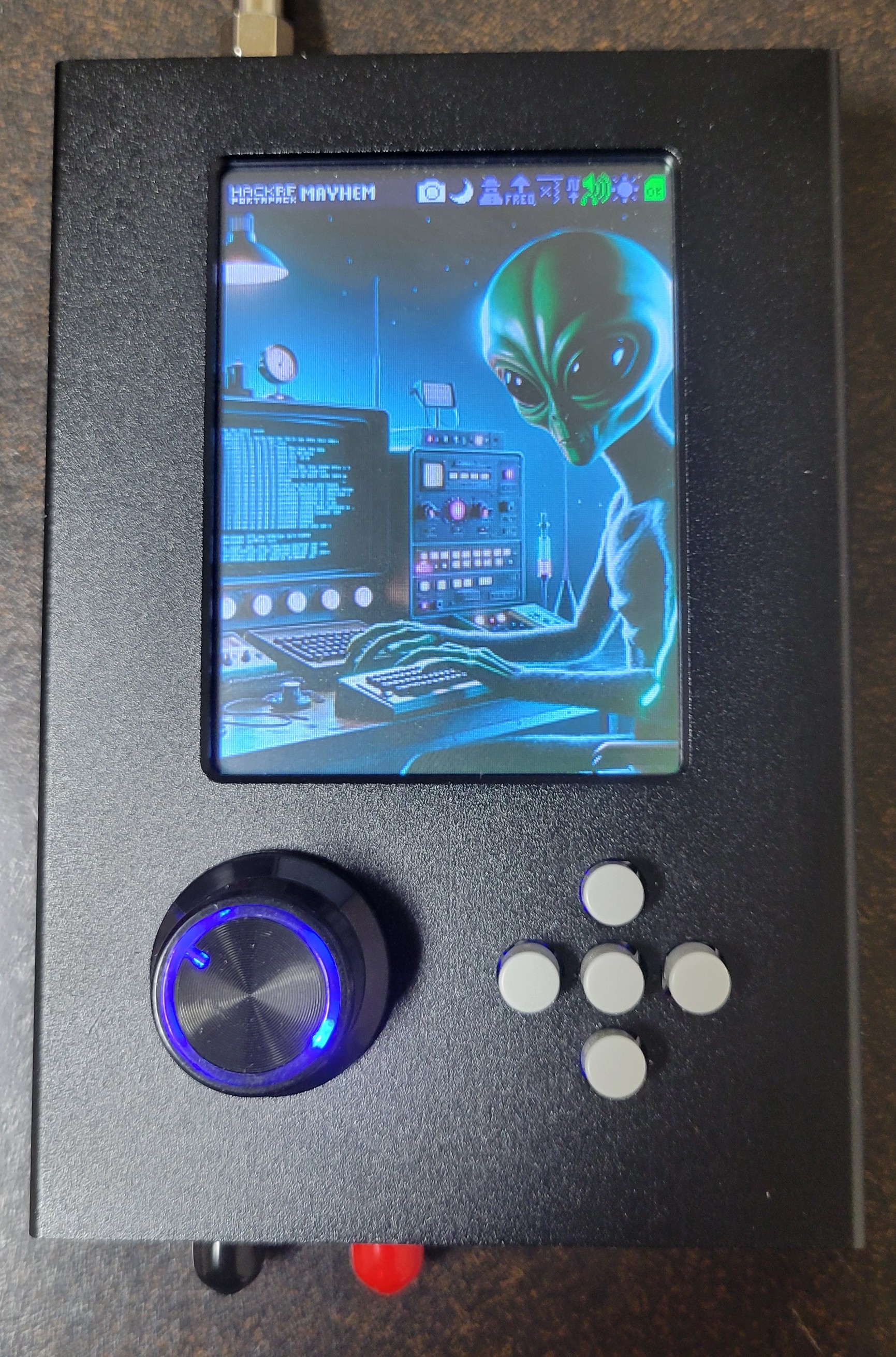
Firmware ↔ Device matrix. The HackRF One (with a PortaPack) runs Mayhem — the canonical PortaPack firmware; the bench
portaunit runs Mayhem today. The firmware deep dive covers its apps, capture/replay, and update flow. (Part of the Firmware ↔ Device “runs on” matrix.)
1.1 About this Series
This is Volume 1 of a twelve-volume reference for the HackRF One software-defined radio (SDR) and the PortaPack H2 add-on — together commonly sold as the “H2R4” bundle when paired with a HackRF One revision-4 board. The series is written for an engineer’s bench. It treats the user as someone who reads schematics, recognises the parts in a block diagram, knows what a mixer does, and would rather be told that the LO synthesizer is a Qorvo RFFC5072 with a 1.5 Hz step size than be told that “the HackRF can tune to almost any frequency”.
The series is structured by subsystem and workflow rather than by tutorial:
Table 1 — The series is structured by subsystem and workflow rather than by tutorial
| Vol | Title | Audience focus |
|---|---|---|
| 1 | Series Overview, the H2R4 Bundle, and the Upgrade Landscape (this) | What the platform is, where it sits, what’s on the bench |
| 2 | The HackRF One RF Chain & the Revision Matrix (r1 → r10) | Schematic-grade RF front-end walk + every PCB rev’s delta |
| 3 | The Digital Subsystem — LPC4320, CoolRunner-II CPLD, SGPIO, Clocks | How samples actually move from the ADC to USB |
| 4 | Firmware, DFU, Recovery, and Building from Source | hackrf firmware source tree, DFU, hackrf_spiflash, version pinning |
| 5 | Host Tooling — hackrf_* CLI, libhackrf, Python | Day-to-day driver, capture, sweep, debug |
| 6 | GNU Radio Companion 3.10+ Workflows | osmocom source, common flowgraphs, OOT modules |
| 7 | Protocol Analysis — URH, Inspectrum, SigDigger | IQ → bits → packets → state machine, decoders |
| 8 | Antennas, LNAs, Filters, and the 8-bit ADC’s Dynamic-Range Budget | Real-world front-end pairing for the bands you care about |
| 9 | The PortaPack H2 — Hardware, and the H1 / H2+ / H4 / H4M Comparison | Schematic walk + a defensible upgrade-path matrix |
| 10 | Mayhem Firmware — App Catalog, Navigation, Plugins, Building | The standalone-radio personality |
| 11 | Operations, RF Safety, Legal, and Lab Discipline | Capture/decode/replay end-to-end, FCC Part 15 / Part 97, never-TX list |
| 12 | Cheatsheet — The Laminate-Ready Field Card | One-pagers; the synthesis volume |
Each volume has its own contents table, footnoted citations, cross-references to neighbouring volumes, and a closing resources block. The hyperlinks between volumes are real (this is an HTML render — the source markdown is the same that pandoc could turn into docx if you want a printed copy later). Cross-references appear as “Vol n §x.y” — Cmd/Ctrl-clicking jumps; back-arrow returns.
If you already know which subsystem you need to understand, skip to the corresponding volume. Volumes 2 and 3 together are the schematic walk; Volume 9 is the equivalent for the PortaPack add-on. Volumes 5–7 are the software workflow. Volumes 8 and 11 are bench discipline. Volume 12 is the printable summary.
1.2 What the HackRF Is — and What It Isn’t
1.2.1 What it is
The HackRF One is a half-duplex software-defined radio peripheral that reaches from 1 MHz to 6 GHz, samples (or generates) up to 20 MS/s of complex baseband at 8-bit resolution, and connects to a host computer over USB 2.0 high-speed. It is open-hardware (CERN OHL) and open-firmware (GPL). It is the de-facto wideband SDR of the open-source community: dozens of tools assume its presence and dozens of published research projects target it as their reference platform^[Michael Ossmann, “HackRF: An Open Source SDR Platform” — DEF CON 21 launch talk, 2013, set the project’s positioning. The product has shipped since 2014 with the same fundamental architecture.].
Operationally the HackRF gives you four different things at once:
- A wideband receiver that scans a band, captures IQ to disk, and lets you analyse it later in any of half a dozen graphical tools (gqrx, CubicSDR, SDR++, GNU Radio, SigDigger, Inspectrum).
- A wideband transmitter that plays back arbitrary IQ at the same rate range. With the HackRF’s modest +10 to +15 dBm output you can replay a captured remote-control signal, transmit ham-band experiments under a license, or feed a benchtop antenna for testing your own receivers — but you are not operating a base station.
- A spectrum-survey instrument via
hackrf_sweep, which steps the LO across a wide range and shows you a coarse FFT picture of “what’s transmitting where”. It is to a $30,000 Anritsu what a digital multimeter is to a Fluke 8588: the same shape of measurement, with the precision rounded off until the price drops two orders of magnitude. - A target for embedded hacking and firmware work — the firmware is GPL, the schematic is public, and the LPC4320 in the middle is reachable over JTAG via the same Black Magic Probe / J-Link tools you’d use for any other Cortex-M4F design.
When you bolt a PortaPack H2 onto the top, the same hardware becomes a standalone handheld — the LPC4320 boots Mayhem firmware, drives a 320×240 LCD, takes input from a navigation control, and runs a catalogue of receive/transmit/decode apps without a host computer.
1.2.2 What it isn’t
A HackRF One is not:
- A high-dynamic-range receiver. The 8-bit ADC gives roughly 50 dB of in-band dynamic range^[Theoretical 8-bit SNR: 6.02 × 8 + 1.76 ≈ 49.8 dB. Real-world HackRF One performance typically lands at ~48–52 dB depending on gain settings.]. A strong signal in the band of interest desensitises the receiver for everything else. For weak-signal HF DX work the SDRplay RSPdx or the Airspy HF+ Discovery (both 12-bit+) are dramatically better; for general benchwork the HackRF’s wider tuning range still wins.
- Frequency-stable. The factory reference is a 25 MHz crystal — not a TCXO. Frequency drift over 30 minutes can be tens of ppm; absolute-frequency claims should not be made until either the unit has been warmed up for half an hour or an external 10 MHz reference has been wired to the front-panel CLKIN. The HackRF Pro’s built-in TCXO removes this complaint (Vol 2 §4 walks the upgrade rationale.)
- Full-duplex. You cannot transmit and receive at the same time — there is one analogue chain, multiplexed by the SKY13350/SKY13453 RF switches. Anything that requires hearing an acknowledgement during transmission needs either two HackRFs synchronised over a shared clock^[See
hackrf_clockand the synchronisation checklist at https://hackrf.readthedocs.io/en/latest/synchronization_checklist.html.] or a different platform (LimeSDR, USRP, BladeRF). - A jammer or a high-power transmitter. With +10 to +15 dBm of TX power and a stock antenna, the HackRF’s range is short by design — a few metres into a benchtop antenna, perhaps tens of metres into a tuned outdoor antenna. Pairing with a power amplifier crosses regulatory and ethical lines that this series treats explicitly in Vol 11.
- A toy. The hardware is precise enough, and the software stack mature enough, that real research happens on this device — published exploits against rolling-code remotes, ADS-B reception, GSM passive surveys, ZigBee mesh analysis, BLE traffic capture. The legal and ethical envelope is real (Vol 11). Treat it accordingly.
1.2.3 Where it sits in the lineup
Table 2 — 2.3 Where it sits in the lineup
| Tool | Frequency range | TX? | Sample rate | Best at |
|---|---|---|---|---|
| Flipper Zero | 300–928 MHz (sub-GHz) | yes (limited) | n/a | Field instrument for known sub-GHz protocols |
| HackRF One | 1 MHz – 6 GHz | yes | 20 MS/s | Lab analysis of arbitrary signals + transmit experiments |
| RTL-SDR | 24 MHz – 1.7 GHz | no | 2.56 MS/s | $30 receive-only spectrum survey + ADS-B + casual decode work |
| Proxmark3 RDV4 | 125 kHz / 13.56 MHz only | yes | n/a | Lab-grade RFID/NFC research |
The HackRF is the lab-grade SDR — the device you reach for when the Flipper Zero says “I see a signal but I don’t know that protocol”. You bring the HackRF to capture the IQ, walk it through Universal Radio Hacker or GNU Radio to understand its structure, and then either (a) write a Flipper FAP that decodes it natively for field use, or (b) keep it as a HackRF + GRC workflow because the protocol is too complex to fit on the Flipper.
For the cross-tool comparison see _shared/comparison.md.
1.3 The H2R4 Bundle — What’s on the Bench
The phrase “H2R4” is a bundle name — two designators concatenated:
- H2 = PortaPack H2 (the LCD + control add-on PCB that bolts onto the HackRF One’s expansion header).
- R4 = HackRF One hardware revision r4 (manufactured 2014–2020).
Per Great Scott Gadgets’s revision matrix^[https://hackrf.readthedocs.io/en/latest/list_of_hardware_revisions.html — the canonical revision list. Revision strapping pins were added in r6 onwards, so r1–r4 cannot self-identify in firmware; the silkscreen near U18 (MAX5864) is the source of truth.], r2, r3, and r4 are electrically identical to r1 — only the silkscreened revision number differs across manufacturing runs. Every component, every value, every routing detail is the same as the 2014 first-shipping board.
That means the r4 in front of you behaves exactly like the device every published HackRF tutorial, every academic paper, every YouTube walkthrough since 2014 was written about. There is no “is my unit too old” doubt — the r4 is the canonical HackRF One.
1.3.1 What’s in the bundle
The genuine GSG H2R4 bundle through an authorised reseller typically contains:
Table 3 — The genuine GSG H2R4 bundle through an authorised reseller typically contains
| Item | Quantity | Notes |
|---|---|---|
| HackRF One r4 board | 1 | Aluminium-housed, SMA female RF, micro-USB (r4 era predates USB-C) |
| PortaPack H2 | 1 | 2.4″ 320×240 TFT LCD, 5-way nav stick, headphone jack, microSD slot |
| ANT500 telescopic antenna | 1 | 75 cm whip, SMA male, 75 MHz – 1 GHz primary use |
| micro-USB cable | 1 | Quality varies — replace with a known-good shielded cable for serious work (Vol 2 §6.3) |
| Acrylic / 3D-printed shell | 1 | Protects the H2 PCB and screen; clones often skip this |
| Pre-flashed Mayhem firmware | (on H2) | Reseller-flashed; first thing to do is upgrade to current nightly (Vol 10 §3) |
What’s typically not included:
- LiPo battery (PortaPack H2 supports a JST-PH 3.7 V cell ~1500–2000 mAh; not always shipped because of air-freight battery rules).
- microSD card (the H2 needs one to log captures and to hold app payloads).
- Higher-band antenna (ANT500 is sub-1 GHz; for 2.4 / 5.x GHz work you need ANT700 or a mounted antenna of choice).
- USB-C-to-micro-USB adapter (most modern bench setups assume USB-C upstream).
Vol 8 §3 covers the antenna selection in detail.
1.3.2 Identifying genuine GSG vs clone
Even when sourced from an authorised reseller, the first bench task is a positive identification. The relevant checks:
-
USB enumeration. A genuine HackRF One running stock firmware enumerates as USB VID:PID 1d50:6089 with manufacturer string
Great Scott Gadgets. A unit in DFU mode enumerates as 1d50:6088. Clones frequently use generic IDs like0x04b4:1234. From a Linux host:$ lsusb | grep -i hackrf Bus 003 Device 005: ID 1d50:6089 OpenMoko, Inc. HackRF OneThe vendor ID
1d50is registered to OpenMoko, Inc., and is shared with several open-hardware projects^[https://devicehunt.com/view/type/usb/vendor/1D50/device/6089]. -
hackrf_infooutput. Runhackrf_infoand look at the reported board ID, part ID, serial number, and (from r6+) hardware revision. Genuine GSG boards report consistent serial-number formatting (16 hex characters, two 32-bit halves). Clones sometimes report all-zero or duplicate serials. -
Firmware fingerprint. A board running stock GSG firmware will report a release version string that matches one of the official tagged releases on
github.com/greatscottgadgets/hackrf/releases. Anything else suggests a third-party fork — common with PortaPack-bundled units that ship a stale build. -
Above-1-GHz performance. Clones have been documented as ~22 dB worse than genuine units at 6 GHz, with broadband performance issues across the whole RF range^[https://www.rtl-sdr.com/comparing-a-hackrf-clone-against-the-original/ — RTL-SDR.com’s bench comparison from 2021. Not all clones are bad — some are bench-quality — but the variance is real and the worst clones are very bad.]. The bench check is
hackrf_sweep -f 1000:6000against a known reference (a strong cellular tower; a known WiFi access point at 5.8 GHz) and verifying the noise floor and signal level look right. -
PCB silkscreen. Genuine GSG boards have the revision number printed near U18 (MAX5864). Counterfeit units sometimes either (a) omit this, (b) screen “r1” because the BOM is r1-vintage and they did not refresh it, or (c) mismatch — claim r9 on silkscreen but ship r1-era components.
For the porta unit on this bench: the silkscreen reads “HackRF One” + “30 October 2022” with no GSG branding (so it’s not genuine), but it’s also not a generic clone — it’s the Clifford Heath modified design, manufactured by JSTVRO. See §3.3 for what that actually means. Vol 2 §8 documents the bench-test procedure end-to-end so any of these checks can be reproduced on a unit of unknown provenance.
1.3.3 The Clifford Heath modified version — a deliberately-improved ‘clone’
Not every non-GSG HackRF is a cheap copy. The most consequential exception is the Clifford Heath modified design (github.com/cjheath/hackrf), which improves the open-hardware reference in ways GSG declined to merge upstream.
The story: Heath designed a series of RF front-end modifications and offered them to Michael Ossmann (GSG) as a pull request. Ossmann rejected the PR. Heath then worked directly with manufacturers — JSTVRO, Rabbit Labs, OpenSourceSDRLab, Wired Hatters, SDR Store — to produce the modified design under various brands and case treatments. The Mayhem firmware project tracks Heath’s variant on a dedicated wiki page: Clifford’s-version.
The modifications, all on the RF front end (the main signal-path silicon — MAX2837, RFFC5072, MAX5864, LPC4320, Si5351 — is unchanged):
Table 4 — The modifications, all on the RF front end (the main signal-path silicon — MAX2837, RFFC5072, MAX5864, LPC4320, Si5351 — is unchanged)
| What Heath changed | Stock GSG part | Heath replacement | Why |
|---|---|---|---|
| Antenna-line protection | (none) | CLA4611-085LF | Protects both LNA and TX amp from transmit-into-mismatch and out-of-spec RX. Headline mod. |
| MMIC amplifiers | MGA-81563-TR1G | TRF37B73 | Modern part, broader operating range, the MGA is obsolete |
| RF switches | SKY13350-385LF | SKY13453-385LF | Current production (the same switch GSG moved to in r6/r8/r10 — Heath went there earlier) |
| Bias-T design | original | improved | Better high-frequency response, better RF sensitivity even when disabled |
The newer Heath revisions (USBC V1, sold by Rabbit Labs; R10 / R10+, sold by OpenSourceSDRLab and Wired Hatters; H4M Clifford Edition, sold by SDR Store) add USB-C in place of the legacy USB mini-B. The pre-USBC-V1 Heath revisions (which is what porta is) keep mini-B, matching the original r4/R5 reference connector.
What this is not: a sensitivity tune or a power upgrade. The Mayhem wiki testing is honest about it — user reports on receiver sensitivity vs. genuine GSG are mixed (some better, some worse), and there’s no standardized test methodology. What the Heath design is: a robustness upgrade. The CLA4611-085LF protection is the unambiguous practical win. Blowing the LNA via TX-into-mismatch or hot-RF-into-RX is the most common way HackRFs get bricked, and the Heath protection chip mitigates that.
How to identify a Heath-modified board if it’s in your hands: the silkscreen on the main signal-path side reads “HackRF One™” without “Great Scott Gadgets” or any GSG company branding. The date stamp varies — some Heath manufacturers preserve the canonical “13 February 2014” Gerber date; others restamp with their own production date. The unit on porta’s bench reads “HackRF One™” + “30 October 2022”, no GSG mark; that’s the JSTVRO build pattern (the case label credits “Robert in China” rather than Heath, but the design lineage is Heath’s). The Heath-vs-stock differences are small SMT parts in the network around the antenna SMA — too small to identify from an overview PCB photo. Close-up part-number inspection (CLA4611-085LF antenna protection, TRF37B73 MMICs, SKY13453-385LF switches) is one route, but the reliable identifier is vendor disclosure: vendors selling the Heath design typically advertise it explicitly (“Clifford Heath HackRF USBC V1”, “Clifford 2025 R10+”, “H4M Clifford Edition”). If you bought a JSTVRO-branded HackRF in the H2R4 / H2 bundle around 2022–2024, it is almost certainly a Heath-modified board.
1.4 The HackRF One Hardware Family — How r4 Fits
The HackRF One has shipped in eight production revisions across eleven calendar years (r5 was experimental and never manufactured). Most of the deltas are sourcing-driven — the project leans on a small number of specialised RF parts (MAX2837 transceiver, RFFC5072 mixer, Si5351 clock generator, MAX5864 dual ADC/DAC), and when those parts have gone allocation-constrained the design has had to substitute. The result is a revision matrix that looks like a spaghetti diagram if you read it cold but makes perfect sense once you understand the supply-chain pressure:
Table 5 — The HackRF One has shipped in eight production revisions across eleven calendar years (r5 was experimental and never manufactured). Most of the deltas are sourcing-driven — the project leans on a small number of specialised RF parts (MAX2837 transceiver, RFFC5072 mixer, Si5351 clock generator, MAX5864 dual ADC/DAC), and when those parts have gone allocation-constrained the design has had to substitute. The result is a revision matrix that looks like a spaghetti diagram if you read it cold but makes perfect sense once you understand the supply-chain pressure
| Rev | Years | Switches | Transceiver | Clock gen | Antenna feed | Why this rev exists |
|---|---|---|---|---|---|---|
| r1–r4 | 2014–2020 | SKY13350 | MAX2837 | Si5351C | (no diode) | Original design + identical reships |
| r5 | — | — | — | — | — | Experimental, never shipped |
| r6 | 2020 | SKY13453 | MAX2837 | Si5351C | (no diode) | SKY13350 hard to source; new switch with simpler control. Rev-strap pins added so firmware can self-identify |
| r7 | 2021 | SKY13350 | MAX2837 | Si5351C | (no diode) | SKY13350 came back; r6 reverted. USB VBUS-detect Rs updated |
| r8 | 2021–2022 | SKY13453 | MAX2837 | Si5351C | (no diode) | SKY13350 went away again |
| r9 | 2023 | SKY13453 | MAX2839 | Si5351A + extra distribution | diode | The chip-shortage rev: MAX2837 unavailable, substituted MAX2839. New clock-distribution to compensate. Series diode at antenna feed protects against external LNA bias mishaps |
| r10 | 2024+ | SKY13453 | MAX2837 | Si5351C | diode | Reverts r9 back to r8 silicon (MAX2837 returned). Keeps the antenna-feed diode improvement |
The r4 in your bundle is the original design — same parts, same routing, same RF performance as the day Michael Ossmann shipped the first batch. Vol 2 walks the schematic in detail.
The interesting thing for “should I upgrade?” planning (Vol 2 §10) is that r10 is functionally the closest current GSG part to an r4. Both run the MAX2837. Both run the Si5351C. The only thing r10 does differently from r4 is (a) the SKY13453 switches (better part, no behavioural difference at the firmware level) and (b) the bias-T series diode (a safety improvement; matters if you intend to use bias-T-powered active antennas).
In other words: the r4 you have is not “old hardware” in any meaningful sense — it is the same hardware GSG ships today with two minor manufacturing improvements layered in. The case for an r10 upgrade is weak unless you specifically want bias-T safety or have damaged the r4. The case for a HackRF Pro upgrade is much stronger and quite different — see the next section.
A wrinkle worth noting for the Clifford Heath modified r4 design (see §3.3): that variant already brings the SKY13453 switches forward (the r6 / r10 improvement) and adds the CLA4611-085LF antenna protection chip that no GSG revision has. The Heath-modified board is in some respects ahead of a stock r10 on robustness, while still being r4-vintage on the digital section and the main RF transceiver chain.
1.5 The HackRF Pro — When the Pro Is Worth $400
Great Scott Gadgets announced HackRF Pro on 2025-06-26^[https://greatscottgadgets.com/2025/06-26-meet-hackrf-pro/], opened pre-orders through authorised resellers in summer 2025, and started shipping in September 2025. As of HackRF firmware v2026.01.1 (the current release as of this volume), the Pro is supported in legacy compatibility mode — anything that runs on a HackRF One runs on the Pro — with extended-precision modes coming in subsequent firmware drops^[https://github.com/greatscottgadgets/hackrf/releases/tag/v2026.01.1 — release notes from January 2026 confirm initial Pro support with future precision-mode enablement.].
What the Pro changes versus the One:
Table 6 — What the Pro changes versus the One
| Axis | HackRF One | HackRF Pro | Why this matters in practice |
|---|---|---|---|
| Frequency range | 1 MHz – 6 GHz | 100 kHz – 6 GHz operating; tunable 0 Hz – 7.1 GHz | Pro sees HF directly without a Ham-It-Up upconverter |
| Reference | 25 MHz crystal | Built-in TCXO | No more 30-min warm-up before frequency claims; absolute frequency drift drops from tens of ppm to sub-ppm |
| Transceiver | MAX2837 (or MAX2839 on r9) | MAX2831 | Different IF/baseband front-end with flatter response and improved IIP3 |
| Glue logic | Xilinx CoolRunner-II XC2C64A CPLD | Lattice iCE40 UltraPlus FPGA | More gates → headroom for sample-pipeline improvements; iCE40 has a well-loved open toolchain (Yosys + nextpnr) |
| Flash | Winbond W25Q80BV (8 Mbit) | Winbond W25Q32 (32 Mbit) | 4× the firmware budget; future feature additions don’t have to fight for space |
| Bandwidth | 20 MHz | 20 MHz initially; planned wider modes | Software-driven — the FPGA enables future expansion |
| Half/full duplex | Half | Half | Both still half-duplex |
| Price | ~$300 retail | $400 through resellers | $100 premium |
The decision is not really about “is the Pro better?” — it obviously is, on every axis. The decision is “is the $100 premium worth it for the work I’m doing?”. The honest answer:
- Yes, get the Pro if (a) you do significant HF work and have been working around the One’s 1 MHz lower limit with a Ham-It-Up upconverter, or (b) you make absolute-frequency claims (RF compliance work, GPS-disciplined references, ham-radio digital modes that demand stable carriers) and the One’s crystal drift is a daily friction point.
- Stay with the One if (a) your work is mostly above 100 MHz with a tolerance for a few-ppm drift, (b) you’ve already invested in upconverters or external GPSDOs that take care of the One’s weaknesses, or (c) you want to learn the One’s open-firmware deeply — the One is the documented, tutorial-rich device; the Pro’s firmware ecosystem is still catching up.
For the H2R4 specifically: the Pro is interesting as a future second device (pair an r4 + H2 for the standalone Mayhem workflow with a Pro on the bench for stable-frequency lab work). It is not a “throw the r4 out” upgrade. Vol 2 §10 expands this analysis into a decision tree.
1.6 The PortaPack Family — H1 through H4M
The PortaPack is a community add-on, not a Great Scott Gadgets product. It was originated by Jared Boone (sharebrained.com) as an LCD + nav-control accessory that piggybacks on the HackRF One’s expansion header, providing the PortaPack with access to the LPC4320, the I²S audio codec lines, and the ADC/DAC clock. The hardware has gone through five generations:
Table 7 — The PortaPack is a community add-on, not a Great Scott Gadgets product. It was originated by Jared Boone (sharebrained.com) as an LCD + nav-control accessory that piggybacks on the HackRF One's expansion header, providing the PortaPack with access to the LPC4320, the I²S audio codec lines, and the ADC/DAC clock. The hardware has gone through five generations
| Variant | Year | Display | Power switch | USB | Audio | Battery telemetry | GPIO | Firmware |
|---|---|---|---|---|---|---|---|---|
| H1 | ~2016 | 2.4″ 320×240 TFT (TN) | momentary push | from HackRF | through HackRF audio | none | none | sharebrained → Mayhem (legacy) |
| H2 | 2020–2022 | 2.4″ 320×240 TFT (TN) | momentary push | from HackRF | through HackRF audio | none | none | Mayhem |
| H2+ | 2022 | 2.4″ 320×240 TFT (TN) | momentary push | from HackRF | through HackRF audio | none | none | Mayhem |
| H4 | 2023 | 2.4″ 320×240 IPS | sliding (full cut) | USB-C | dedicated codec | basic | I²C breakout | Mayhem |
| H4M | Q4 2024 | 2.4″ 320×240 IPS, anti-glare | sliding (full cut) | USB-C | dedicated codec + auto headphone/speaker switch | percent + voltage + current + ETA | I²C-capable GPIO connector | Mayhem (co-developed) |
The H4M is the current best-of-class. It addresses every reasonable complaint about the H2: phantom drain when “off” (sliding switch fully isolates the battery), poor screen visibility (IPS + anti-glare), no battery information (full telemetry exposed in firmware), micro-USB (USB-C with faster charging), no audio path (dedicated codec with auto-routing), no I/O for accessories (I²C-capable GPIO connector). It costs $50–100 more than an H2 bundle and the consensus on r/HackRF and the Mayhem GitHub issues is that it is worth the premium^[https://www.rtl-sdr.com/a-review-of-the-new-hackrf-portapack-h4m/ — the RTL-SDR.com review from 2025 walks the full upgrade rationale and confirms the firmware-level battery features.].
For the H2 specifically: it is not obsolete — Mayhem firmware is maintained for H1/H2/H2+/H4/H4M in parallel, and every feature listed in Vol 10’s app catalogue runs identically on the H2 as on the H4M. The downsides of the H2 are quality-of-life (phantom drain, mirror-prone screen, no battery info) rather than capability. If the H2 is bench-tethered most of the time, those downsides do not bite. If it spends time in a backpack, an H4M upgrade pays for itself in not-having-to-charge-tomorrow.
Vol 9 walks the H2 schematic and the H1 → H4M comparison in full. Vol 10 covers the firmware that runs on both.
1.7 The Decision Tree — When to Reach for the HackRF
A signal exists in the band of interest → what do I want to do?

├── Just listen to a known modulation (FM voice, AM aviation,
│   broadcast, weather sat APT, NOAA, ADS-B 1090 MHz)
│   → reach for an RTL-SDR ($30) and gqrx / SDR++ / dump1090.
│     The HackRF works too, but is overkill.
│
├── Listen to something below 24 MHz (HF — ham, time signals,
│   aviation HF, marine HF)
│   → HackRF + Ham-It-Up upconverter, OR HackRF Pro
│     (which sees HF directly thanks to its 100 kHz lower limit).
│
├── Capture an unknown sub-GHz signal off a remote, sensor, or
│   short-range telemetry
│   ├── Flipper-known protocol → use the Flipper Zero in the
│   │   field; it is the right tool.
│   ├── Unknown protocol → HackRF + Inspectrum/URH on a laptop.
│   │   Capture as `.cfile`, walk it through URH for protocol
│   │   structure, decode in GNU Radio or write a Flipper FAP
│   │   once the protocol is understood.
│
├── Survey the spectrum across multiple bands
│   → `hackrf_sweep -f 1:6000` is the right tool. RTL-SDR is too
│     narrow (covers 24 MHz – 1.7 GHz) and slower per-band.
│
├── Transmit a captured signal back (replay attacks, sensor
│   testing under your own license / on your own hardware)
│   → HackRF (the ONLY half-decent open-hardware TX-capable SDR
│     under $500). Stay within license / ownership limits — Vol 11.
│
├── Decode something that requires bit-level synchronous timing
│   below 8 µs (ZigBee, BLE, advanced WiFi)
│   → HackRF + GNU Radio with the right OOT module (gr-zigbee,
│     gr-bluetooth, etc.). This is real research-grade work.
│
└── Operate as a handheld — capture, decode, sometimes transmit —
    away from a laptop
    → HackRF One + PortaPack (H2 today; H4M for the upgrade) running
      Mayhem firmware. This is the H2R4 use case.
The decision tree’s branches map onto the volumes:
- Sub-GHz unknown-protocol work → Vol 6 (GRC) + Vol 7 (URH) workflow.
- Spectrum survey → Vol 5 (
hackrf_sweep) + Vol 6 (FFT in GRC). - HF work → Vol 8 (Ham-It-Up + antenna selection) or eventual Pro upgrade per Vol 5.
- Replay / TX → Vol 5 + Vol 11 (legal/ethics).
- Synchronous bit-level decode → Vol 6 + Vol 7.
- Handheld field use → Vol 9 (PortaPack hardware) + Vol 10 (Mayhem firmware).
1.8 The Software Ecosystem — What Talks to a HackRF
The HackRF presents itself to the host as a USB device implementing a relatively simple protocol that libhackrf wraps. From libhackrf the rest of the software stack flows out:
Table 8 — The HackRF presents itself to the host as a USB device implementing a relatively simple protocol that libhackrf wraps. From libhackrf the rest of the software stack flows out
| Layer | Software | What it does |
|---|---|---|
| Driver / kernel | libusb + udev rules | USB transport; no kernel module |
| C library | libhackrf | Open / close / set-frequency / start-rx / start-tx primitives |
| CLI tools | hackrf_info, hackrf_transfer, hackrf_sweep, hackrf_clock, hackrf_debug, hackrf_spiflash, hackrf_cpldjtag | Day-to-day CLI for capture, sweep, firmware, reference clock |
| Python | pyhackrf2 (pip) | Python wrapper around libhackrf |
| GNU Radio | gr-osmosdr (osmocom) source/sink | Use HackRF inside any GNU Radio flowgraph |
| Graphical receivers | gqrx, CubicSDR, SDR++, SDR# (via shim) | Real-time spectrum + audio demod |
| Protocol analysers | URH, Inspectrum, SigDigger | Capture-then-analyse workflow |
| Automated decoders | rtl_433 (with HackRF source), gr-air-modes, gr-rds, gr-gsm | Specific protocol stacks |
| Standalone firmware | Mayhem (on PortaPack) | LPC4320 boots Mayhem instead of stock HackRF firmware |
Vols 5, 6, 7, and 10 cover these layers in full. The takeaway for Vol 1 is that the HackRF is an instrument with a deep software hinterland — buying the device is the entry fee; the time investment is in learning the half-dozen tools that live above it.
1.9 The Three Currents of Firmware
There are three independent firmware streams in the HackRF world, and they confuse newcomers regularly:
1.9.1 HackRF firmware (host-facing)
The official Great Scott Gadgets firmware that runs on the LPC4320 when the HackRF is plugged into a laptop. It implements the USB protocol, the libhackrf command surface, the hackrf_sweep mode, and the bring-up of the RF chain. Source: github.com/greatscottgadgets/hackrf. Latest: v2026.01.1 (released January 2026)^[https://github.com/greatscottgadgets/hackrf/releases/tag/v2026.01.1].
This is what you flash with hackrf_spiflash when running through hackrf_info’s upgrade prompt. Every fresh reseller-bundled unit should be brought up to current.
Vol 4 covers this firmware end-to-end: the build toolchain (GCC ARM Embedded), the source-tree layout, the DFU recovery procedure, the hackrf_cpldjtag workflow when the CPLD bitstream needs reflashing.
1.9.2 Mayhem firmware (PortaPack-facing)
The community firmware that runs on the LPC4320 when a PortaPack is attached, replacing the stock HackRF firmware. It implements the LCD UI, the navigation control, the on-device app catalogue (~80 apps for receive, transmit, capture, decode, debug), the SD card filesystem, and the standalone-radio modes. Source: github.com/portapack-mayhem/mayhem-firmware. Latest: nightly 2026-05-05 (most recent stable nightly tag: 2026-03-07)^[https://github.com/portapack-mayhem/mayhem-firmware/releases].
Mayhem started as Jared Boone’s sharebrained/portapack-hackrf firmware, was forked by Furrtek, and is now maintained by the Mayhem org. The H4M was co-developed between GSG-PortaPack-vendor and the Mayhem team and the firmware reflects this — H4M-specific features (battery telemetry, audio codec, GPIO) are first-class.
Vol 10 covers the Mayhem firmware end-to-end: app catalogue organised by RX / TX / Utility / Debug, the navigation conventions, the settings.ini file, building from source, the OTA / SD-card update workflow, the plugin ecosystem.
1.9.3 CPLD bitstream (CoolRunner-II)
The Xilinx CoolRunner-II XC2C64A CPLD on the HackRF One holds a small bitstream that translates between the MAX5864’s parallel ADC/DAC interface and the LPC4320’s SGPIO pins. This bitstream is not the same thing as the firmware — it’s a much smaller artefact (a few KB) and changes very rarely. Source: in the same greatscottgadgets/hackrf repo under firmware/cpld/sgpio_if/. Updated via hackrf_cpldjtag after a fresh firmware flash.
Vol 3 §5 walks the CPLD’s role; Vol 4 §6 walks the hackrf_cpldjtag recovery procedure.
The HackRF Pro replaces the CoolRunner-II with an iCE40 UltraPlus FPGA, which has roughly 6× the LUT count and an open-source toolchain (Yosys + nextpnr). Vol 4 §10 covers the Pro’s flash / FPGA-config workflow.
1.10 Cost Reference
Approximate retail prices in May 2026, from authorised US/EU resellers:
Table 9 — Approximate retail prices in May 2026, from authorised US/EU resellers
| Item | Approx price | Notes |
|---|---|---|
| HackRF One r10 (genuine GSG, bare) | $300 | What you buy if you want a HackRF One today |
| HackRF One r4 + PortaPack H2 bundle | $300–350 | Used / NOS — the H2R4 bundle |
| HackRF One + PortaPack H4M bundle | $400–500 | Current best handheld bundle |
| HackRF Pro (genuine GSG, bare) | $400 | Sept 2025 launch |
| ANT500 antenna (replacement) | $30 | Often included in bundles |
| ANT700 antenna | $40 | For 400 MHz – 7.2 GHz work |
| NooElec Ham-It-Up upconverter | $50 | HF (0–30 MHz) into HackRF One — Pro doesn’t need this |
| Mini-Circuits ZRL-1150LN+ LNA | $90 | Small-signal LNA for above 1 GHz |
| LiPo 1500 mAh JST-PH (PortaPack) | $15 | For handheld H2/H4 use |
| 32 GB microSD (PortaPack) | $10 | Mayhem capture / app payload storage |
| External 10 MHz GPSDO reference | $80–250 | When you need absolute-frequency stability without buying a Pro |
| 50 Ω SMA dummy load | $8 | Mandatory for any TX bench testing — Vol 11 |
| RF shielded enclosure (Faraday tent) | $100–500 | For TX bench testing without radiating outdoors — Vol 11 |
Vol 8 §7 has the full antenna + filter + LNA pairing matrix.
1.11 Where Each Volume Goes Deeper
Table 10 — 11. Where Each Volume Goes Deeper
| Question | Volume |
|---|---|
| What’s actually on the HackRF PCB? | Vol 2 — RF chain walkthrough; Vol 3 — digital subsystem |
| What changed from r4 to r10? Should I upgrade? | Vol 2 §10 |
| What’s the HackRF Pro decision tree? | Vol 1 §5 (this volume) + Vol 2 §11 (technical comparison) |
| How do I update the firmware on a fresh unit? | Vol 4 §3 — DFU + hackrf_spiflash workflow |
| How do I capture an IQ file from the command line? | Vol 5 §4 — hackrf_transfer -r capture.cfile |
| How do I see a spectrum picture? | Vol 5 §6 — hackrf_sweep; Vol 6 §3 — GRC FFT scope flowgraph |
| What’s the right antenna for 433 MHz remotes? | Vol 8 §3.1 |
| How do I figure out an unknown protocol? | Vol 7 §2–4 — URH workflow; §5 — Inspectrum cursors |
| How do I write a GNU Radio flowgraph? | Vol 6 §2 onwards |
| How do I run a HackRF as a handheld? | Vol 9 — PortaPack H2; Vol 10 — Mayhem firmware |
| What apps are on the PortaPack? | Vol 10 §3 — categorised app catalogue |
| Can I transmit on amateur radio bands legally? | Vol 11 §3 — license-conditioned bands; §4 — never-TX list |
| What’s the lab discipline for TX work? | Vol 11 §5 — dummy load, Faraday tent, attenuation |
| The cheatsheet? | Vol 12 — the laminate-ready field card |
1.12 Maintenance, Updates, and Forward-Looking Notes
This series is built to last through the natural pace of HackRF / PortaPack evolution. The expected update cadence:
- Quarterly — refresh the latest-firmware-version line in Vol 4 §3 and Vol 10 §3 from the upstream GitHub release tags. Mayhem releases nightlies almost daily; pin to the most recent stable tag for the canonical reference.
- On hardware-revision change — when GSG ships an r11 (or a hypothetical r12), append a row to the revision matrix in §4 (this volume) and Vol 2 §10. The r9 → r10 transition is the template — the matrix is meant to grow.
- On HackRF Pro firmware milestones — the extended-precision modes are coming; when they ship in upstream firmware, Vol 5 (CLI) and Vol 6 (GRC) need revisits to capture the new sample-rate options and the new flag bits.
- On PortaPack hardware change — when an “H5” appears, append to Vol 9’s comparison matrix.
The source markdown lives in 02-inputs/volume_sources/. The build pipeline (build_html.py and inject_toc.py) lives in 02-inputs/volume_sources/build/. The deliverables under 03-outputs/html/ are regenerable from source. See the README in 02-inputs/volume_sources/ for the rebuild commands.
1.13 Resources
1.13.1 Authoritative documentation
Table 11 — 13.1 Authoritative documentation
| Resource | URL |
|---|---|
| HackRF official docs | https://hackrf.readthedocs.io/en/latest/ |
| HackRF GitHub repo | https://github.com/greatscottgadgets/hackrf |
| HackRF Pro page | https://greatscottgadgets.com/hackrf/pro/ |
| HackRF One page | https://greatscottgadgets.com/hackrf/one/ |
| Hardware revisions list | https://hackrf.readthedocs.io/en/latest/list_of_hardware_revisions.html |
| Hardware components list | https://hackrf.readthedocs.io/en/latest/hardware_components.html |
| Updating firmware | https://hackrf.readthedocs.io/en/latest/updating_firmware.html |
| HackRF Pro launch announcement | https://greatscottgadgets.com/2025/06-26-meet-hackrf-pro/ |
1.13.2 Mayhem / PortaPack
Table 12 — 13.2 Mayhem / PortaPack
| Resource | URL |
|---|---|
| Mayhem firmware | https://github.com/portapack-mayhem/mayhem-firmware |
| Mayhem releases | https://github.com/portapack-mayhem/mayhem-firmware/releases |
| Mayhem wiki | https://github.com/portapack-mayhem/mayhem-firmware/wiki |
| MayhemHub web UI | https://github.com/portapack-mayhem/MayhemHub |
| H4M review | https://www.rtl-sdr.com/a-review-of-the-new-hackrf-portapack-h4m/ |
1.13.3 Software ecosystem
Table 13 — 13.3 Software ecosystem
| Tool | URL |
|---|---|
| GNU Radio | https://www.gnuradio.org/ |
| gr-osmosdr | https://osmocom.org/projects/gr-osmosdr |
| Universal Radio Hacker | https://github.com/jopohl/urh |
| Inspectrum | https://github.com/miek/inspectrum |
| SigDigger | https://github.com/BatchDrake/SigDigger |
| gqrx | https://gqrx.dk/ |
| CubicSDR | https://cubicsdr.com/ |
| SDR++ | https://sdrpp.org/ |
| pyhackrf2 | https://pypi.org/project/pyhackrf2/ |
| Michael Ossmann’s free SDR course | https://greatscottgadgets.com/sdr/ |
1.13.4 Community
Table 14 — 13.4 Community
| Forum | URL |
|---|---|
| r/HackRF | https://reddit.com/r/HackRF |
| RTL-SDR.com (HackRF tag) | https://www.rtl-sdr.com/tag/hackrf/ |
| GSG Slack | (linked from https://greatscottgadgets.com/hackrf/) |
1.13.5 Books and free curricula
Table 15 — 13.5 Books and free curricula
| Resource | URL or citation |
|---|---|
| ”Software Defined Radio with HackRF” — Michael Ossmann | https://greatscottgadgets.com/sdr/ |
| PySDR — Marc Lichtman | https://pysdr.org/ |
| GNU Radio tutorials | https://wiki.gnuradio.org/index.php/Tutorials |
1.13.6 In-series cross-references
This volume’s footnotes draw on every other volume; the main entries:
Table 16 — This volume's footnotes draw on every other volume; the main entries
| Volume | Topic |
|---|---|
| Vol 2 §10 | r4 → r10 upgrade decision tree (technical) |
| Vol 2 §11 | HackRF Pro vs HackRF One technical comparison |
| Vol 4 §3 | DFU and hackrf_spiflash recovery |
| Vol 4 §6 | hackrf_cpldjtag CPLD bitstream flashing |
| Vol 8 §3 | Antennas paired with HackRF |
| Vol 9 | PortaPack H2 schematic walk + comparison matrix |
| Vol 10 §3 | Mayhem app catalogue |
| Vol 11 §3 | Legal frequency boundaries |
| Vol 11 §4 | Never-TX list |
| Vol 11 §5 | Bench TX discipline (dummy load + Faraday tent) |
| Vol 12 | Laminate-ready cheatsheet |
Comments (0)