M5Stick S3 · Volume 4
M5Stack M5StickS3 Volume 4 — Hat + Unit Ecosystem
Hat2 accessories, Grove Units, family-form-factor compatibility map across M5Stack lineup
4.1 About this volume
Vol 4 catalogs the expansion modules that fit the M5StickS3. Three official buses (Hat2 top + Grove side + USB-OTG side) plus DIY.
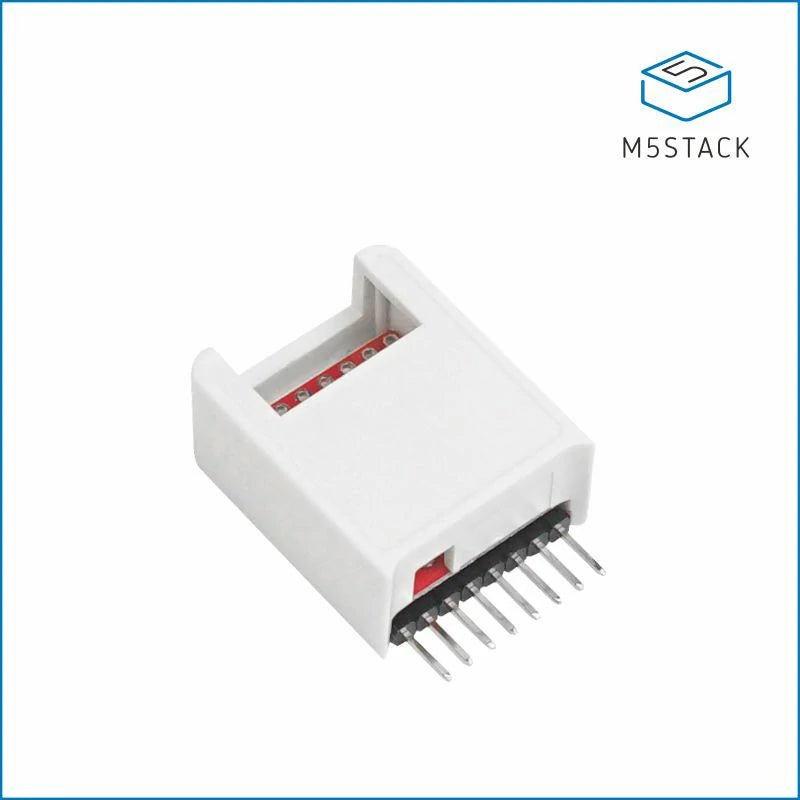
The compatibility-map confusion is the load-bearing topic in this volume. M5Stack uses similar-sounding names for different connectors across product families. The family-compatibility map in § 2 is the first thing to read; it’s the most common source of new-user confusion.
4.2 The Hat vs Cap vs HAT-original vs ATOM connector family
M5Stack ships several different expansion connectors across their product families. The names are confusing because some share words (“HAT” vs “Hat2” vs “Hat”); the physical connectors are not interchangeable.
Table 1 — 2. The Hat vs Cap vs HAT-original vs ATOM connector family
| Connector name | M5Stack family | Pin count | Physical form | Mating direction |
|---|---|---|---|---|
| Hat2 16-pin | M5StickS3 (this device), possibly future S3 sticks | 16 pin | 2.54 mm 2-row header | Top-mounting |
| HAT-original 8-pin | M5StickC / Plus / Plus 2 (classic ESP32) | 8 pin pogo | Pogo pin connector | Top-mounting |
| Cap 14-pin EXT | Cardputer ADV only | 14 pin | 2.54 mm 2-row header | Bottom-mounting (daughter card) |
| Atom 8-pin | Atom / Atom S3 family | 8 pin | Pogo pin or pin header | Top-mounting |
| Core / Core2 / CoreS3 | M5Stack core devices | Multiple variants | Stacking bus pins | Bottom-stacking |
| Faces | M5Core | Bus-edge pins | Various | Bottom-attach |
Common-confusion warnings:
-
“M5StickC HAT modules” do NOT fit M5StickS3. Different connectors entirely. The StickC HAT uses 8-pin pogo connectors; the M5StickS3 has a 16-pin 2.54 mm header. Physically incompatible.
-
“Cardputer Cap modules” do NOT fit M5StickS3. The Cardputer ADV’s Cap modules use a 14-pin underside header; M5StickS3 uses a 16-pin top header. Physically incompatible.
-
“M5Atom HAT modules” do NOT fit M5StickS3. Atom HATs use 8-pin pogo; M5StickS3 uses 16-pin header. Physically incompatible.
-
Product page might say “for M5Stick series” but be HAT-original, not Hat2. Always verify the physical connector before purchasing accessories.
The connector-name confusion has resulted in many forum posts of users buying the wrong accessory. The mitigation: memorize the device → connector mapping for the M5Stack lineup before shopping accessories.
4.3 Hat2 accessories that fit the M5StickS3
As of 2026-05-13, the Hat2 accessory ecosystem is thin — the M5StickS3 is recent enough that the third-party Hat2 catalog hasn’t fully filled in. Expect this to grow.
Likely M5Stack-released Hat2 accessories (based on historical M5Stack patterns):
Table 2 — Likely M5Stack-released Hat2 accessories (based on historical M5Stack patterns)
| Hat2 accessory | Function | Status |
|---|---|---|
| Hat2 microSD holder | Adds microSD storage (M5StickS3 has none on-board) | Likely / TBD |
| Hat2 GPS module | Standalone GNSS receiver (alternative to Grove GPS V2) | Likely / TBD |
| Hat2 RTC + backup battery | Real-time clock with coin-cell backup for timestamped logs | Possible |
| Hat2 audio jack breakout | 3.5 mm headphone output (M5StickS3 has none on-board) | Possible |
| Hat2 LoRa module | SX1262 LoRa radio — would be a major M5StickS3 upgrade | Hopeful — closes the LoRa gap |
| Hat2 prototyping board | Bare 16-pin breakout for custom builds | Likely / TBD |
| Hat2 environmental sensor | SHT4x / BMP280 / etc. | Possible |
| Hat2 LED matrix | 8×8 RGB LED matrix for status/animation | Possible |
Verify M5Stack’s actual Hat2 catalog at https://shop.m5stack.com/collections/m5stack-hats when shopping. Filter for Hat2-specific accessories (not HAT-original 8-pin pogo).
Most-impactful Hat2 accessories for M5StickS3 use cases:
- Hat2 microSD holder — enables capture-to-SD for Wi-Fi sniffing, audio recording. Without it, the 8 MB on-board flash + 8 MB PSRAM are the only storage.
- Hat2 LoRa module (if released) — closes the LoRa gap; brings the M5StickS3 to Meshtastic-capable parity with the Cardputer ADV + Cap LoRa-1262.
- Hat2 audio jack — 3.5 mm headphone output for non-speaker audio playback (less obtrusive for wearable use).
Until the Hat2 ecosystem matures, Grove Units fill most accessory needs.
4.4 Grove Unit ecosystem (shared with Cardputer ADV)
The Grove HY2.0-4P port on M5StickS3 accepts the same Grove Units as the Cardputer ADV. The catalog is large; this section curates the most-useful Units for M5StickS3 use cases specifically.
Full Cardputer ADV Grove Unit catalog: ../../../M5Stack Cardputer ADV/03-outputs/Cardputer_ADV_Complete.html Vol 4 § 3.1. This volume references that catalog and adds M5StickS3-specific commentary.
4.4.1 Curated Grove Units for M5StickS3
Table 3 — 4.1 Curated Grove Units for M5StickS3
| Unit | Chip | Bus | Use case | Approx. price |
|---|---|---|---|---|
| Unit GPS V2 | u-blox AT6558 | UART | Most impactful: adds GNSS to M5StickS3 (which has none on-board, unlike Cardputer ADV + Cap LoRa-1262) | ~$12 |
| Unit RFID2 | WS1850S | I²C | NFC read/write — Mifare, NTAG, FeliCa. Used by Bruce/Marauder | ~$12 |
| CC1101 Sub-GHz Unit | TI CC1101 | SPI (Grove + bit-bang) | Sub-GHz fixed-code replay (433/868 MHz) | ~$10 |
| Unit C6L | ESP32-C6 + SX1262 | UART | Standalone Meshtastic node — alternative LoRa path without Hat2 LoRa | ~$15 |
| Unit ENV IV | SHT40 + BMP280 | I²C | Temp + humidity + pressure for ESPHome | ~$10 |
| Unit IR (with RX) | Generic 940 nm | GPIO | Additional IR range/coverage; M5StickS3 already has IR TX+RX but a Grove IR Unit can sit on the desk facing differently | ~$5 |
| Atomic GPS Kit | u-blox NEO-M8N | UART | Higher-grade GNSS with backup battery (faster TTFF) | ~$20 |
| Unit Thermal MLX90640 | MLX90640 | I²C | 32×24 IR thermal imaging (cardputer-thermal port works on M5StickS3) | ~$50 |
| Unit OLED 0.42” | SSD1306 128×64 | I²C | Second tiny screen for status (mostly redundant given M5StickS3’s display) | ~$5 |
| PaHub | TCA9548A | I²C | I²C mux — 6 channels for multiple I²C peripherals at conflicting addresses | ~$5 |
| Unit ToF / ToF4M | VL53L0X / VL53L1X | I²C | Distance ranging (0-2 m / 0-4 m) | ~$8 |
| Unit Servo / Stepper / Relay | Various | I²C / GPIO | Actuator family | $5-15 |
M5StickS3-specific recommendations:
- First Grove Unit to buy: Unit GPS V2 if Meshtastic-class GNSS work is in scope; otherwise Unit ENV IV for general environmental sensing.
- Skip Unit OLED — M5StickS3’s display is already small; second OLED is rarely useful.
- PaHub is critical if multiple I²C sensors are in scope — only the secondary Grove I²C bus has space for them.
4.4.2 Grove I²C bus management
The Grove port is single — only one Unit at a time without a hub. For multiple Units simultaneously:
- PaHub I²C mux — fan out to 6 I²C channels. Same physical bus, different address spaces (devices on different channels can have conflicting addresses).
- Mix Hat2 (one accessory) + Grove (one accessory) — two independent buses, more capability per device, but only one of each.
Most casual M5StickS3 deployments use one Grove Unit at a time — chosen for the active use case, swapped as needs change.
4.5 USB-C OTG accessories
Via USB-C-to-A adapter, M5StickS3 acts as USB host. Useful accessories:
Table 4 — Via USB-C-to-A adapter, M5StickS3 acts as USB host. Useful accessories
| Accessory | Use case | Notes |
|---|---|---|
| USB-to-Serial console adapter (FTDI / CH340 / CP210x / PL2303) | Portable serial console for field router/switch debugging | Convert M5StickS3 into a temporary terminal. Display shows serial output; Buttons control input commands. |
| USB mass-storage thumb drive | Read/write external storage; supplements M5StickS3’s lack of microSD | File browsing via custom firmware |
| USB-MIDI controller | MIDI input to M5StickS3 audio codec for synth use | Less common but possible |
| USB HID device for BadUSB Hunter inspection | Inspect plugged-in HID devices for surreptitious-keyboard detection | Defensive use case (NEMO has this) |
| USB keyboard | Larger keyboard for typing | Less useful on M5StickS3’s tiny screen than on Cardputer ADV |
Doesn’t work (as of 2026-05-13):
- USB Wi-Fi adapters (no CDC-ECM driver in stock firmware)
- USB Ethernet adapters
- Webcams (no UVC driver)
- High-current USB peripherals (> 500 mA) — will brownout the M5StickS3
Power-budget caveat: M5StickS3’s 5V boost is smaller than Cardputer ADV’s. High-current OTG peripherals need a powered USB-C hub or external power source.
4.6 DIY hardware patterns
4.6.1 Grove I²C sensor breakout
For sensors not available as M5Stack Grove Units, cut a Grove HY2.0 cable and wire to a generic I²C sensor breakout. Pattern is identical to Cardputer ADV Vol 4 § 6.1 — see that section for the full walkthrough.
Brief recap:
Grove cable                  Sensor breakout
───────────                  ────────────────
Black  (GND)  ───────────── GND
Red    (5V)   ── (optional AMS1117-3.3) ── VCC (3.3V-only sensors)
White  (G2)   ───────────── SDA
Yellow (G1)   ───────────── SCL
Arduino code: Wire1.begin(2, 1); then standard I²C library calls on Wire1.
4.6.2 Custom Hat2 daughterboard
For ambitious builders: design a 16-pin Hat2 daughterboard. Process:
- Mechanical reference: M5Stack publishes Hat2 mechanical specs in the M5StickS3 Structure Files PDF (when published). Verify the pin pitch (2.54 mm), the header position relative to the case top, and the available height under the Hat (limited by the M5StickS3’s small enclosure).
- Electrical reference: use the Hat2 pinout from Vol 3 § 4.1 (verify against vendor PDF).
- PCB design: KiCad / EasyEDA / Altium. Hat2 PCB is small — match the M5StickS3 enclosure top dimensions (~24×24 mm).
- Add a 16-pin female header at the matching position for mating with the M5StickS3 male header.
- Order from JLCPCB / PCBWay — small Hat2 PCB ~$5-15 for a small run.
Community Hat2 concepts (none currently shipping):
- LoRa Hat2 (SX1262 — would close the LoRa gap)
- CC1101 sub-GHz Hat2 (smaller form factor than the Grove CC1101 Unit)
- microSD Hat2 (essential for capture-heavy workflows)
- 3.5 mm audio jack Hat2 (more discreet than the speaker)
- Rechargeable LiPo Hat2 (extra capacity beyond the 250 mAh on-board)
4.6.3 USB-OTG accessory builds
Building a custom USB-OTG peripheral that interfaces with M5StickS3:
- USB HID custom keyboard — small mechanical or sensor-based input device that registers as a keyboard. M5StickS3 firmware reads HID events and interprets them as commands.
- USB audio adapter — external DAC/headphone amp + USB audio class device. M5StickS3 streams ES8311 audio out via USB to the external DAC.
- USB device fingerprinter — pass-through USB host that logs descriptor of any plugged-in device. Defensive use case.
These are advanced builds — most users will use off-the-shelf USB peripherals + adapters.
4.6.4 Magnetic-back accessory mounting
The M5StickS3’s magnetic back enables passive mounting without dedicated holders. DIY accessories:
- Magnetic wristband — third-party silicon/elastic wristband with a thin metal disc; M5StickS3 sticks to it. Most M5StickC accessory wristbands work physically; verify thickness against M5StickS3’s case before purchase.
- Magnetic clip-on — metal clip on a key fob, lanyard, or jacket pocket. M5StickS3 sticks. Position-flexibility friendly.
- Drone/RC vehicle frame mount — magnetic disc bonded to the frame; M5StickS3 sticks for aerial-platform Wi-Fi capture or telemetry display.
- Fixed deployment surfaces — metal lockers, file cabinets, server racks, fridges. Stick the M5StickS3 + start capture + walk away.
The magnetic-back form factor is the M5StickS3’s operationally distinctive hardware feature — it enables deployment scenarios the Cardputer ADV physically cannot.
4.7 Module-selection decision tree
                    Need _____ ?
                         │
       ┌─────────────────┼─────────────────┐
       │                 │                 │
  GPS / GNSS?       I²C sensor       More storage?
       │                 │                 │
       ↓                 ↓                 ↓
  Unit GPS V2       Grove I²C        Hat2 microSD
  (Grove UART)      sensor breakout  holder (when
                    via Wire1        shipping)
                                          OR
                                     USB-OTG thumb
                                     drive

       │                 │                 │
  NFC?              Sub-GHz radio?    Wearable
       │                 │            deployment?
       ↓                 ↓                 │
  Unit RFID2 OR     CC1101 Grove          ↓
  PN532 Grove       OR future          Use magnetic
                    Hat2 LoRa /        back + DIY
                    CC1101 Hat2        wristband / clip

       │                 │
  Multiple I²C    USB-host peripheral
  devices?        access (BadUSB Hunter,
       │          field serial console)?
       ↓                 │
  PaHub I²C        OTG with USB-C-to-A
  mux              adapter
Hat2 vs Grove for the same function: prefer Grove when the Unit exists and you only need one of that function. Prefer Hat2 when the device has no on-board access (microSD, audio jack) and the Hat2 accessory specifically adds it.
4.8 Resources
Vendor
- M5Stack Hats catalog: https://shop.m5stack.com/collections/m5stack-hats
- M5Stack Units catalog: https://shop.m5stack.com/collections/m5stack-units
- M5StickS3 product page: https://shop.m5stack.com/products/m5sticks3-esp32s3-mini-iot-dev-kit
- M5StickS3 Structure Files PDF (for custom Hat2 design): https://docs.m5stack.com/ (when published)
Community / third-party
- Cardputer Wiki (much applies to M5StickS3): https://cardputer.wiki/
- M5Stack Discord (Hat2 catalog announcements)
- r/m5stack (Reddit) — DIY builds + accessory reviews
Cross-references
- Cardputer ADV module ecosystem (canonical reference):
../../../M5Stack Cardputer ADV/03-outputs/Cardputer_ADV_Complete.htmlVol 4 - Hat2 pin assignments: Vol 3 § 4
- USB-OTG modes: Vol 3 § 5
- BadUSB Hunter use case detail: Vol 9 § 6
This is Volume 4 of a twelve-volume series. Next: Vol 5 walks the audio subsystem in full — the standout feature of the M5StickS3, with ES8311 + MEMS mic + AW8737 amp + speaker enabling voice recording, FFT, wake-word, walkie-talkie, internet radio.
Comments (0)