Ruckus Game Over · Volume 1
Game Over Module — Volume 1
About the Series + Identity & Lineage
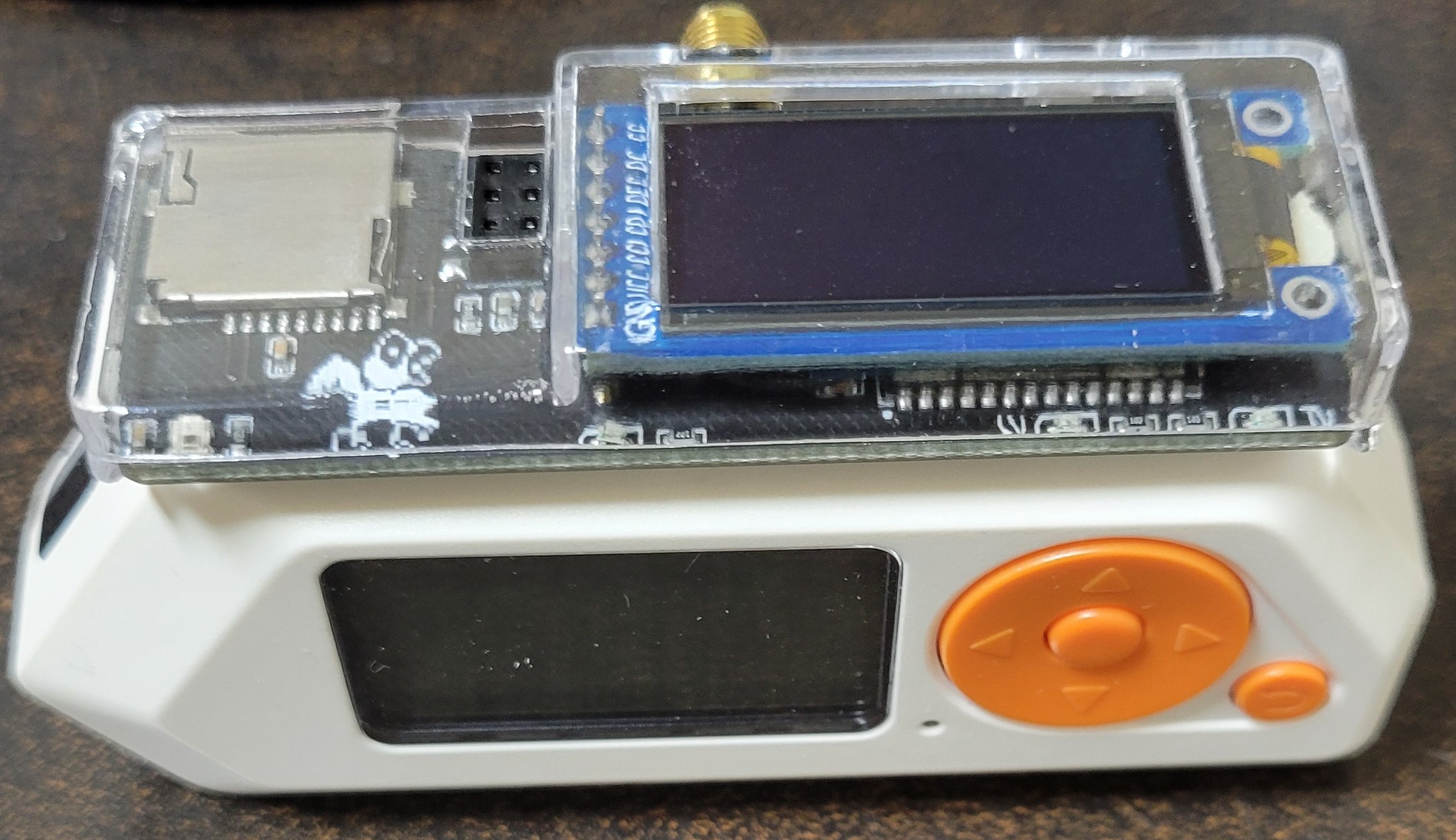
Firmware ↔ Device matrix. The Game Over module runs a closed-source vendor fork of ESP32 Marauder Firmware (derived from, but not in sync with, mainline) — and also takes upstream Marauder, Ghost ESP, or custom IDF builds. (Part of the Firmware ↔ Device “runs on” matrix.)
1.1 About this series
The Game Over module is a third-party Flipper Zero accessory from ruckus // section80 (Australia) — the most popular all-in-one multi-radio Flipper add-on of its generation, with onboard ESP32-S3, OLED + joystick UI, microSD, and a swappable daughter-card expansion slot that takes either a CC1101 (sub-GHz) or NRF24 (2.4 GHz) module. It can run tethered to a Flipper or fully standalone, which is the “what makes it interesting” trait.
This is an eight-volume module-scoped deep dive. The umbrella Flipper Zero deep-dive series covers Game Over as a section in Vol 9 § 2.2 — short-form, catalog-style. This series goes deeper on:
- The firmware sourcing situation (no public GitHub for the Ruckus
Marauder fork; distribution via the vendor’s
dirty_flasherBETA tool — Vol 3). - Install procedures for vendor binary, upstream Marauder, Ghost ESP, custom IDF builds (Vol 4).
- Flipper firmware compatibility — the vendor explicitly tests against Unleashed; what the lineage analysis means for Momentum / RogueMaster / Xtreme / Official compatibility (Vol 5).
- The bricking allegations (Feb 2026 reviews report damaged Flippers) — Vol 7 has a sub-chapter that investigates this without editorializing.
- Operating workflows for both standalone and Flipper-bridged use, including the daughter-card swap procedure (Vol 6).
1.1.1 Reading order
- Vol 1 (this volume) — series intro, identity, lineage, where Game Over sits in the third-party-module landscape.
- Vol 3 — firmware ecosystem and the supply-chain caveat. Read this before flashing anything.
- Vol 7 — known issues including the bricking-allegations investigation. Read before mounting on a Flipper you can’t afford to lose.
- Vol 4 — install procedures.
- Vol 5 — Flipper-FW compatibility — pick a Flipper firmware that the vendor has actually tested.
- Vol 2 — hardware reference (read alongside Vol 4 when needed).
- Vol 6 — operating workflows.
- Vol 8 — legal/ethics + lab fit + references.
Vols 2 and 6 are reference material; you don’t need to read them sequentially. Vols 3, 5, and 7 are the load-bearing decision-support volumes — the ones that change your behavior with the device.
1.1.2 Conventions
- Vendor = ruckus // section80 throughout this series.
- The Flipper = the Flipper Zero hosting the module.
- The board or the module = the Game Over module itself.
- Marauder without qualification = the upstream
justcallmekoko/ESP32Marauderfirmware; the Ruckus Marauder fork is always called out explicitly. - The OLED = the onboard display. The board has only one display.
- The expansion slot or the daughter slot = the 8-pin recessed header that accepts a CC1101 or NRF24 daughter card.
1.2 What Game Over actually is
Game Over is a Flipper Zero GPIO module — a board that mounts on the Flipper’s 18-pin GPIO header and adds capabilities the Flipper itself doesn’t have. Specifically it adds:
- Wi-Fi (2.4 GHz only) + BLE via an onboard ESP32-S3.
- Either sub-GHz (433/868/915 MHz, via a swappable CC1101 daughter card) or 2.4 GHz NRF24 (mousejack-class radio, via a swappable NRF24 daughter card). One at a time. The slot is not dual-populated.
- An OLED screen and joystick — a full standalone UI so the board doesn’t need a Flipper to be useful. This is the single biggest Game-Over-specific advantage over the official WiFi Devboard.
- A microSD card slot for PCAP capture and log storage.
- External SMA antenna for the ESP32-S3, plus a separate antenna path for the daughter card.
Importantly, the Flipper Zero already has an onboard CC1101 of its own (sub-GHz on 433/868/915 MHz). The CC1101 in the Game Over daughter slot is a second sub-GHz radio, not a replacement for the Flipper’s. They can be used independently — but not transmitted simultaneously without caution; antenna co-location is real (Vol 7 § 4 covers the gotcha).
Game Over also has Marauder companion FAP support, meaning when mounted on a Flipper you can drive the ESP32-S3 from the Flipper’s UI rather than the OLED. Both modes work. The “killer feature” is being able to operate without a Flipper at all.
1.2.1 Vendor-stated form factor
The Tindie product page (canonical primary source) describes the board as:
flipper zero wifi gpio module oled esp32 s3 (wifi) cc1101 (subghz) nrf24 (2.4ghz)
GAME OVER is an all-in-one GPIO board with an OLED screen, it does it all. The board comes pre-flashed with Wifi Marauder and is ready to be used right out of the box.
The “does it all” claim is roughly true: Wi-Fi auditing, sub-GHz, mousejacking, BLE work, plus a screen so the Flipper isn’t required. Where it’s not true: there’s no NFC, no IR, no SD-via-Flipper bridge, no 5 GHz Wi-Fi. Capabilities-vs-board-level-ceiling is in Vol 2 § 8.
1.2.2 Architecture clarification (correction to earlier docs)
Earlier internal notes — including
Flipper Zero/02-inputs/volume_sources/research_notes/modules_owned.md
in its 2026-05-09 revision — describe Game Over as having “ESP32-S3 +
CC1101 + NRF24” all permanently onboard, with an additional 8-pin slot
for a daughter card. That description is structurally wrong.
The vendor’s own Tindie page is unambiguous:
An expansion slot that can be used for either a CC1101 (used for external subghz at extended ranges ~ both 433mhz & 900mhz supported) or a NRF24 (used for 2.4ghz mouse jacking) module.
The CC1101 and NRF24 are mutually exclusive daughter cards in a single
shared expansion slot. The board ships with ESP32-S3 onboard always;
neither CC1101 nor NRF24 is permanently on the main board. Some
listings (Tindie variants, reseller packaging) bundle one or both daughter
cards; some don’t. The Flipper Zero CLAUDE.md Hardware-On-Hand bullet
(“ESP32-S3 + CC1101 + NRF24”) inherits this confusion and should be
treated as “ESP32-S3 onboard, plus daughter cards in the box” rather than
a tri-radio fixed BOM.
This series uses the corrected architecture. Vol 9 § 2.2 will be cleaned up the next time it’s edited; the existing prose remains correct in spirit but inaccurate in detail.
1.3 Maker — ruckus // section80
ruckus // section80 is a one-person hardware shop based in Australia, operating primarily through Tindie. The maker’s handle is ruckus; section80 is the workshop name. Combined branding (“ruckus // section80”) appears on all listings and packaging.
The shop has been active on Tindie since at least 2023. Game Over’s Tindie listing has 14 reviews ranging from April 2024 through February 2026, covering both the End Game predecessor and the current Game Over generation, indicating a sustained commercial run rather than a one-off build.
Disambiguation. “Ruckus” is also the name of an enterprise Wi-Fi equipment vendor (formerly Ruckus Wireless, now part of CommScope / RUCKUS Networks) — completely unrelated. Web searches for “Ruckus firmware” return enterprise-Wi-Fi results that have nothing to do with the Flipper accessory. When citing this series, use “ruckus // section80” or “section80 Game Over” to disambiguate.
1.3.1 The vendor’s posture
From observed behavior on Tindie reviews and product-page text, the vendor:
- Acknowledges the upstream: “Full credit to justcallmekoko for wifi marauder firmware.” This matters because the firmware shipped pre-loaded on the board is a fork of upstream Marauder, not a clean-room rewrite — see Vol 3 for what that means in practice.
- Pushes firmware updates in response to user feedback. A Feb 2026 review explicitly thanks the vendor for pushing an update after troubleshooting a problem.
- Provides direct technical support through Tindie’s messaging.
- Distributes firmware via a vendor-controlled tool called
dirty_flasher(BETA) rather than a public GitHub repo. This is the supply-chain caveat discussed at length in Vol 3.
1.3.2 The “End Game” predecessor
Before Game Over, the shop sold a board called End Game. The Tindie listing for End Game is still online but flagged as superseded. Game Over is described on its own page as “the successor to the end game.”
The differences between End Game and Game Over are not explicitly documented by the vendor, but observable from listings and review metadata:
Table 1 — metadata
| Trait | End Game | Game Over |
|---|---|---|
| Headline radio | Single-purpose ESP32 + CC1101 or NRF24 (varied by SKU) | ESP32-S3 onboard + swappable daughter slot |
| OLED + joystick | Smaller / simpler | Standardized, snug joystick (up/push/down) |
| microSD | Variable | Standard |
| Standalone use | Limited | First-class — full menu UI |
| Marauder integration | Earlier fork | Current Ruckus Marauder fork |
For practical purposes End Game is legacy — Game Over supersedes it, the firmware path is documented for Game Over only, and second-hand End Game units should be retired in favor of either a Game Over or one of the alternatives discussed in § 4 below.
1.4 The third-party module landscape (where Game Over sits)
Game Over competes with several other “all-in-one” Flipper accessories, each with different trade-offs:
Table 2 — each with different trade-offs
| Module | Maker | Onboard radios | Daughter slot | Display + UI | Fits best when… |
|---|---|---|---|---|---|
| Game Over | ruckus // section80 | ESP32-S3 (Wi-Fi/BLE) | Yes — CC1101 OR NRF24 | OLED + 3-way joystick | You want a multi-radio handheld with sub-GHz extended range, can swap roles, OK with proprietary firmware distribution |
| AWOK Dual Touch V3 | AWOK Dynamics | Dual ESP32-WROOM (Wi-Fi/BLE × 2) + GPS | No | 2.8” resistive touchscreen | Wardriving (Wi-Fi + GPS), dual-ESP parallelism. No sub-GHz, no NRF24. |
| Mayhem v2 | Erwin Ried | ESP32-S (Wi-Fi/BLE) + camera | NRF24 OR CC1101 | None (Flipper only) | The camera is the differentiator. Otherwise similar to Game Over. |
| WiFi Devboard (official) | Flipper Devices | ESP32-S2 WROVER | No | None | You want first-party support. No multi-radio, no screen. |
| Apex 5 | HoneyHoneyTeam | ESP32-C5 (dual-band Wi-Fi 6 incl. 5 GHz) + 2× CC1101 + NRF24 + GPS | No | None | Newest gen. 5 GHz Wi-Fi. No screen. |
| FlipMods Combo | Sacred Labs | ESP32 + NRF24 + CC1101, all permanent | No | None | Cheaper than Game Over, no screen, no daughter slot. |
| Rek5 QUAD | rek5lab | ESP32 + CC1101 + NRF24 + GPS | No | None | Similar BOM to FlipMods at slightly lower price. |
| CaracalDB | CaracalDB | ESP32 + NRF24 + CC1101 | No | None | Ships with a printed case; otherwise generic. |
Game Over’s distinguishing pitch in this lineup is the combination of OLED + joystick (so it’s usable as a handheld, no Flipper required) and the swappable daughter slot (mission-configurable: sub-GHz one day, mousejack the next, no need to buy two boards).
1.4.1 When Game Over wins
- You want a handheld Wi-Fi auditor that can also do sub-GHz, but you only need one of those at a time.
- You want a board that’s usable solo — a Flipper isn’t always with you, or you’re using the Flipper for something else simultaneously.
- You want flexibility over time — start with the CC1101 daughter, swap to NRF24 when the next job calls for it, vs. buying two single- purpose boards.
1.4.2 When something else wins
- Wardriving with GPS → AWOK Dual Touch V3. Internal GPS, dual-ESP for parallel Wi-Fi work, larger screen. (See the AWOK deep dive.)
- 5 GHz Wi-Fi auditing → Apex 5. Game Over’s ESP32-S3 is 2.4 GHz only.
- First-party support / regulatory comfort → WiFi Devboard (official).
- Cheap permanent triple-radio → FlipMods Combo or Rek5 QUAD.
- Camera-based work → Mayhem v2.
1.5 What’s in the box (stock variants)
The Game Over Tindie listing has multiple SKU variants depending on what daughter cards and antennas are bundled. The bare-minimum sale is the module + 3D-printed case only — no daughter card, no antenna. You add daughter cards and antennas as separate options at checkout.
The vendor explicitly notes:
Product images displaying modules/antennas are for demonstration purposes only.. flipper zero is not included with sale.
Practically, you should buy:
- Game Over module + case (always).
- At least one daughter card — typically CC1101 (if you don’t already have a sub-GHz path that’s better than Flipper-stock; many buyers own the AWOK or Apex 5 for Wi-Fi and want Game Over for the sub-GHz daughter), or NRF24 (if mousejacking is the goal).
- An antenna for the daughter card if it’s CC1101 (433 MHz or 900 MHz, depending on what you target). NRF24 daughter cards usually come with their own small antenna or have a fixed PCB trace antenna.
- An antenna for the ESP32-S3 SMA — typically a 2.4 GHz “rubber ducky” 3 dBi or so.
The vendor’s own warning is unambiguous:
Do not run any modules without an antenna attached, as you will damage them.
Powering up an unmatched RF transmitter at full power is a known way to fry the PA stage. Don’t.
1.6 Pricing and availability
As of early 2026, observed Tindie pricing is roughly:
Table 3 — As of early 2026, observed Tindie pricing is roughly
| Item | Approximate price (USD) |
|---|---|
| Game Over module + case (no daughters, no antennas) | $90–$120 |
| + CC1101 daughter card | +$15–$25 |
| + NRF24 daughter card | +$10–$20 |
| + 2.4 GHz Wi-Fi antenna (3 dBi rubber duck) | +$5–$10 |
| + 433 MHz / 900 MHz antenna (sub-GHz duck) | +$10–$15 |
| Realistic complete kit | $130–$180 |
This puts Game Over in the same price band as AWOK Dual Touch V3 ($140– 180) and Apex 5 ($99 base, ~$150 kitted) — broadly equivalent budget-wise, with the differentiation being feature mix rather than cost.
Shipping is from Australia, which means non-AU buyers face longer transit times (1–3 weeks typical) and slightly higher shipping costs than US- or EU-domiciled equivalents.
The vendor periodically lists special editions (a “Talking Sasquach Limited Edition” was observed on the YouTube tutorial channels). These are cosmetic variants — same hardware as the standard product.
1.7 What this series doesn’t cover
Out of scope for this deep dive:
- General Flipper Zero hardware / firmware that isn’t specifically about Game Over’s interaction with the Flipper. See the parent Flipper Zero series Vols 1–7 for that.
- Marauder firmware features in general — see upstream
justcallmekoko/ESP32Marauderdocumentation for the canonical feature list. This series covers what’s different about Marauder when running on Game Over hardware specifically. - End Game module operation — superseded; not covered.
- PortaPack / HackRF / RTL-SDR sub-GHz alternatives — Game Over’s
CC1101 daughter is not a substitute for a real SDR. When the work
calls for an SDR, see
Hack Tools/HackRF One/andHack Tools/RTL-SDR/. - Cellular / LTE work — Game Over has no cellular silicon.
1.8 What’s next
Vol 2 is the hardware reference — schematic-grade walk-through of the ESP32-S3 onboard, the OLED + joystick, the daughter slot architecture with the vendor-published 8-pin pinout, the microSD subsystem, antennas, the power tree, and the 18-pin GPIO header to the Flipper.
Comments (0)