Wi-Fi Pineapple · Volume 21
Hak5 WiFi Pineapple Volume 21 — Cheatsheet
Laminate-ready synthesis — the models, the PineAP suite, the radio roles, the legal line, the playbooks, the checklists
21.1 About this volume
Vol 21 is the cheatsheet — the whole 21-volume series compressed into laminate-ready reference material. Nothing new here; it is pure synthesis. Every entry points back to the volume that carries the full treatment. This is the page you keep open while you work.
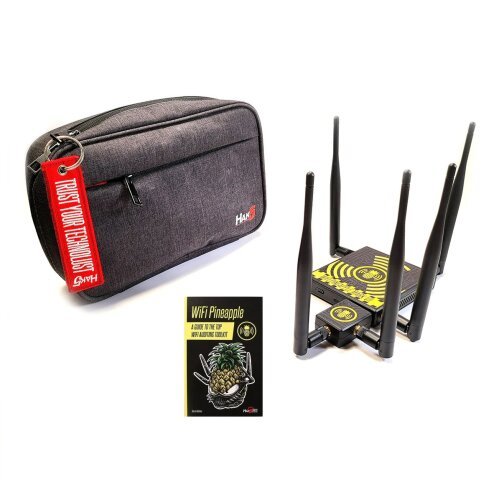
21.2 The four models — quick reference
(Vols 9-15, comparison Vol 16)
Table 1 — 2. The four models — quick reference
| Mark VII | + AC Tactical | Pager | Enterprise | |
|---|---|---|---|---|
| One-line | the baseline puck | baseline + 5 GHz + field kit | the pocket walk-around unit | the rack-mount scale platform |
| SoC | 1-core MIPS | 1-core MIPS | pocket SoC | 4× ARM Cortex-A7 717 MHz |
| RAM/storage | 256 MB / 2 GB | 256 MB / 2 GB | 256 MB / 4 GB | 1 GB / 4 GB |
| Radios | 3 role-based, 2.4 GHz | 3 + MK7AC (5 GHz) | dual array, 2.4/5/6 GHz + BT | 5 dual-band MIMO |
| Power | USB-C | USB-C | 2000 mAh, ~4 h | AC mains |
| Display | none (web UI) | none (web UI) | ~2.4” color + buttons | none (web UI) |
| Form | small puck | puck + kit, in a case | pocket handheld | rack-mount metal |
| Scale | small | small | small | ~100 DHCP clients |
| Best for | learning / standard pentest | the recommended FIRST buy | walk-around / BT / 6 GHz | agency / large / permanent |
| Deep dive | Vols 9-10 | Vol 11 | Vols 12-13 | Vols 14-15 |
First buy: Mark VII + AC Tactical (Vol 16 §6). Acquisition order: Mark VII+AC → Pager → Enterprise (Vol 16 §7). The line is a matrix, not a ladder — pick by deployment shape, not “best.”
21.3 The PineAP suite — quick reference
(Vol 3)
   PASSIVE (generally lawful as recon — Vol 4)
   ────────────────────────────────────────────
   Recon ................. the interactive airspace view
   Log Probes ............ record the probe requests clients broadcast
   Log Associations ...... record who associates to what

   ACTIVE  (** authorization required ** — Vol 4, Vol 8)
   ────────────────────────────────────────────
   Allow Associations .... KARMA — answer "yes" to probed SSIDs
   PineAP Daemon ......... the engine: Beacon Response + the
                           Broadcast SSID Pool
   Beacon Response ....... actively beacon the pooled SSIDs
   Capture SSIDs to Pool . harvest probed SSIDs into the pool
   Deauthentication ...... force a client off its AP
   Evil Twin ............. impersonate a specific real AP

   TARGETING (scope discipline — Vol 3 §8, Vol 8 §3)
   ────────────────────────────────────────────
   Source / Target MAC ... scope PineAP to the authorized
                           target(s) — NOT the whole airspace
The gate: every ACTIVE item crosses the Vol 4 legal line — authorization artifact first, MAC targeting scopes it. When in doubt, don’t TX.
21.4 Radio roles — quick reference
(Vol 7 §3)
   The role-based radio model — each radio gets a JOB:
     MANAGEMENT ... your connection to the device / web UI
     PineAP ....... being the rogue AP
     MONITOR ...... recon, capture, deauth/injection

   Role separation is WHY a Pineapple attacks AND observes
   at the same time — what a single-radio device cannot do.

   Per-model radio counts:
     Mark VII ......... 3 radios (2.4 GHz) — 1 of each role
     Mark VII + MK7AC . 4 radios — adds a 5 GHz monitor/inject
     Pager ............ dual array, 2.4/5/6 GHz + BT/BTLE
     Enterprise ....... 5 radios — MULTIPLE PineAP + MULTIPLE
                        monitor instances, concurrently
21.5 The legal line — quick reference
   ┌─────────────────────┬──────────────────────────────────┐
   │  LAWFUL (generally) │  AUTHORIZATION REQUIRED          │
   ├─────────────────────┼──────────────────────────────────┤
   │  passive recon —    │  active TX — KARMA, beacon        │
   │  listening,         │  response, deauth, evil twin,    │
   │  Log Probes,        │  the PineAP daemon. ANYTHING      │
   │  Log Associations   │  that TRANSMITS.                 │
   │                     │                                  │
   │  observing YOUR OWN │  unauthorized active TX = a      │
   │  airspace (blue     │  crime (computer-access law)     │
   │  team — Vol 17 §5)  │  AND can be unlawful RF          │
   │                     │  interference (Vol 4 §9, Vol 20  │
   │  owned hardware     │  §5). Both, from one act.        │
   └─────────────────────┴──────────────────────────────────┘

   THE LINE: owned hardware OR explicit written authorization.
   No third lawful category. "When in doubt, don't TX."
   The authorization artifact (Vol 8 §2) — carry it on you.
21.6 Setup playbooks — quick reference
(Vol 17)
Table 2 — 6. Setup playbooks — quick reference
| Playbook | Model | Radios | PineAP | Posture |
|---|---|---|---|---|
| Wardriving (Vol 17 §2) | Pager / Mark VII+AC | all monitor | logging only, daemon OFF | passive — lawful as recon |
| Pentest (Vol 17 §3) | Mark VII + AC | mgmt + PineAP + monitor | full engine, MAC-scoped | auth artifact = step zero |
| Red-team (Vol 17 §4) | Pager / planted Mark VII | minimal footprint | tightly scoped | covert ≠ unauthorized; detection-aware |
| Blue-team (Vol 17 §5) | Enterprise / Mark VII | all monitor | OFF / logging only | passive — lawful w/o per-target auth |
| Lab / learning (Vol 17 §6) | any (Mark VII+AC) | experiment freely | full engine | fully-owned lab = safe-harbour |
21.7 Checklists
   PRE-ENGAGEMENT (Vol 8 §7, Vol 20 §2)
   ────────────────────────────────────────────
   □ authorization artifact — written, specific, ON your person
   □ scope memorised — systems, networks, actions
   □ Management UI Firewall ON (Vol 6 §8)
   □ firmware current (Vol 10 §3); radios role-assigned
   □ modules vetted (Vol 18 §8) — current, maintained,
     source-visible, or not installed
   □ Cloud C2: enrolled ONLY if remote op is needed (Vol 19 §5)
   □ discovery-and-response plan prepared (§ below)
   □ tested in the owned lab first (Vol 17 §6)

   DISCOVERY-AND-RESPONSE (Vol 20 §7)
   ────────────────────────────────────────────
   1. STOP active operations
   2. PRODUCE the authorization artifact
   3. CONTACT the named points of contact
   4. DE-ESCALATE — don't destroy / flee / lie; rely on the artifact
   5. DOCUMENT contemporaneously

   ENGAGEMENT CLOSEOUT (Vol 8 §9, Vol 20 §8)
   ────────────────────────────────────────────
   □ stop PineAP — active window closed
   □ retrieve every device (planted + carried)
   □ restore any changed host/network state — leave clean
   □ secure-wipe captures per the data agreement
   □ tear down added attack surface (C2, mgmt access, modules)
   □ write the report — incl. WHICH CONTROL stops each technique
   □ lessons learned captured

   MODULE VETTING (Vol 18 §8)
   ────────────────────────────────────────────
   □ current? maintained? source-visible? known author?
   □ what does it touch? do I actually NEED it?
   □ a community module = an untrusted ROOT process — treat it so
21.8 Command and UI quick reference
   WEB UI AREAS (Vol 6 §3) — names vary by firmware version
   ────────────────────────────────────────────
   Dashboard ........ device state at a glance
   Recon ............ the interactive airspace view (Vol 3 §4)
   PineAP ........... the attack engine control panel (Vol 3 §6-8)
   Clients .......... seen/connected clients + targeting hooks
   Campaigns ........ scripted audits → reports (Vol 5 §4)
   Modules .......... browse/install/manage modules (Vol 6 §4)
   Settings/System .. networking, Mgmt UI Firewall, firmware,
                      Cloud C2 enrollment, radio role assignment
   Logging .......... probe/association logs, capture artifacts

   THE OPENWRT LAYER (Vol 5 §8) — power-user, via SSH
   ────────────────────────────────────────────
   SSH in ........... reach the modified-OpenWrt underneath
   opkg ............. install OpenWrt packages the UI doesn't expose
   (unsanctioned but real — yours to keep clean across updates)

   THE OFF-DEVICE PIPELINE (Vol 19)
   ────────────────────────────────────────────
   capture on Pineapple → EXPORT off-device →
     Wireshark / tshark .. PCAP analysis
     hashcat mode 22000 .. handshake cracking, on a GPU host
     aircrack-ng suite ... shared 802.11 mechanics
     Kismet .............. recon cross-check
   The Pineapple CAPTURES. The host ANALYSES + CRACKS. (Vol 7 §7)

   FIRMWARE (Vol 10 §3)
   ────────────────────────────────────────────
   "best firmware" = current stable Hak5 release. No alt
   firmware ecosystem. Mark VII images: downloads.hak5.org/pineapple/mk7
21.9 Volume index
Table 3 — 9. Volume index
| Vol | Title | Vol | Title |
|---|---|---|---|
| 1 | Overview, the four models, decision tree | 12 | Pager — hardware & electronics |
| 2 | History & lineage (Fonera → Mark VII → Pager/Enterprise) | 13 | Pager — firmware, operation, mods, use cases |
| 3 | The PineAP technique catalog | 14 | Enterprise — hardware & electronics |
| 4 | Where it fits — hat-colors & the legal line | 15 | Enterprise — firmware, multi-radio, scale, mods |
| 5 | The firmware foundation (OpenWrt, Campaigns, C2) | 16 | Model comparison & which to get first |
| 6 | The web UI & module ecosystem | 17 | Setup playbooks by use case |
| 7 | Generic hardware architecture | 18 | Mods — Hak5 & community |
| 8 | Legal, ethics & OPSEC foundation | 19 | Tooling, integrations & Cloud C2 fleet ops |
| 9 | Mark VII — hardware & electronics | 20 | Operational posture in the field |
| 10 | Mark VII — firmware, operation, mods, use cases | 21 | Cheatsheet (this volume) |
| 11 | Mark VII + AC — the tactical kit and 5 GHz |
Sibling reference: the Ducky Script deep dive — (the physical-access counterpart; combined workflows in its Vol 14, this series’ Vol 19 §7). Hub: ../_shared/comparison.md · ../_shared/legal_ethics.md · the capability matrix.
This is Volume 21 of a 21-volume series — the final volume. The deep dive is complete: Phase 1 / Foundation (Vols 1-8) is what a Pineapple is and does; Phase 2 / Per-model (Vols 9-15) is the four current models in hardware and operation; Phase 3 / Synthesis (Vols 16-21) is the comparison, the playbooks, the mods, the tooling, the posture, and this cheatsheet. Start anywhere the volume index points you; everyone reads Vols 4, 8, and 20.
Comments (0)