M5Stick S3 · Volume 1
M5Stack M5StickS3 Volume 1 — Series Overview, Decision Tree, and Where the M5StickS3 Sits
What the K150 is, why \"S3\" matters (vs StickC Plus 2 classic-ESP32), capability matrix, the audio-subsystem-as-USP, depth indices into Vols 2–12
Firmware ↔ Device matrix. The M5StickS3 runs Evil-M5Project (the Evil-S3 build) — see the firmware deep dive for the fork landscape, build, and flash. (Part of the Firmware ↔ Device “runs on” matrix.)
1.1 About this volume
This is the overview volume of a twelve-volume engineer-grade deep dive into the M5Stack M5StickS3 (vendor SKU K150) — the 2025/2026 ESP32-S3 entry in M5Stack’s “Stick” form-factor family. Pocket-sized, wearable-class, with a real audio subsystem, the M5StickS3 fills a slot that no other tool in the lineup covers cleanly: a covert-form-factor wireless toolkit with voice recording and audio playback that the bench-sized handhelds can’t deliver.
This volume’s job is to anchor the series and tell the reader which of Vols 2–12 covers each subsystem. Vols 2–3 walk the hardware and pinout; Vol 4 covers the Hat + Unit ecosystem; Vol 5 is the audio subsystem deep dive (the standout feature); Vol 6 covers the firmware ecosystem; Vols 7–8 cover programming and flashing; Vol 9 has end-to-end recipes; Vol 10 covers custom firmware development; Vol 11 covers operational posture (the 250 mAh battery + audio-bug-legality landscape); Vol 12 is the laminate-ready cheatsheet.
This volume specifically does not teach the hardware (Vol 2), the audio path (Vol 5), the firmware-fork choice (Vol 6), or the recipes (Vol 9). It teaches what the box is, why “S3” matters, the audio subsystem as the differentiator, and where in the rest of the series to go for each topic.
Cross-reference: the M5Stack Cardputer ADV deep dive at is the canonical reference for shared M5Stack conventions (M5Unified library, M5Launcher catalog, Evil-M5Project family, programming environment setup). This series focuses on the M5StickS3-specific differentiators. Where a topic is covered in depth in the Cardputer ADV series and applies unchanged here, this series will cite the cross-reference rather than re-author.
1.2 What the M5StickS3 is
1.2.1 The K150 SKU
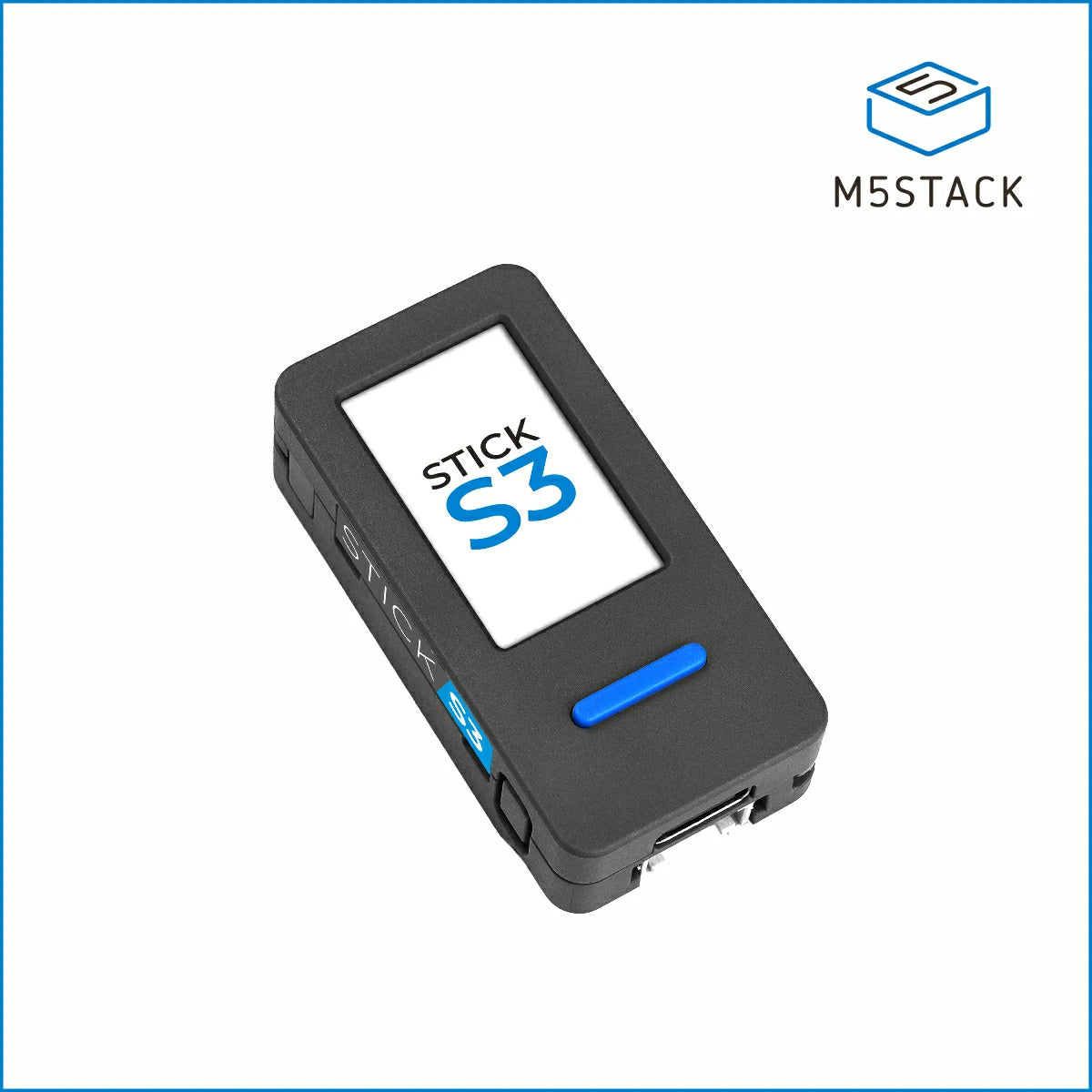
The M5Stack M5StickS3 (vendor SKU K150) is a wrist-watch-sized ESP32-S3 stick with:
- MCU: ESP32-S3-PICO-1-N8R8 (Espressif system-in-package module) — dual-core Xtensa LX7 @ 240 MHz, 8 MB flash + 8 MB OPI PSRAM. The PICO-class SIP is denser than the WROOM-class module used in most other M5Stack S3 hardware.
- Display: 1.14” IPS LCD, 135×240 resolution (portrait native), ST7789P3 controller, SPI-driven. ~260 PPI. Smaller than the Cardputer ADV’s 240×135 (which is the same panel oriented landscape).
- Battery: 250 mAh single-cell LiPo — a sixth of the Cardputer ADV’s 1750 mAh. Battery life is the operational constraint that shapes most use-case decisions.
- Audio chain: ES8311 24-bit I²S codec + MEMS microphone (65 dB SNR) + AW8737 class-D amp + 8 Ω 1 W speaker. Full record-and-playback subsystem — the differentiator vs the StickC Plus 2 (which has only a passive buzzer).
- IR: integrated transmitter AND receiver (the Cardputer ADV has TX only). The receiver enables on-device IR code learning.
- IMU: 6-axis (accelerometer + gyroscope; specific chip — BMI270 or MPU6886 — TBD pending hardware inspection).
- Buttons: programmable; expect StickC-family A/B + power layout.
- Wireless: Wi-Fi 4 (2.4 GHz only, no 5 GHz) + BLE 5.0 (no classic BT — same ESP32-S3 silicon limitation as the Cardputer ADV).
- Expansion: Hat2 bus (16-pin 2.54 mm header) + Grove HY2.0-4P port. The Hat2 bus accepts a different family of accessories from the Cardputer ADV’s 14-pin EXT bus — see Vol 4 for the compatibility map.
- USB: USB-C, native USB-CDC via the ESP32-S3 USB peripheral (no UART bridge chip).
- Storage: No microSD slot built in (a Hat2-class SD card holder can add it as an accessory).
- Form factor: 48 × 24 × 15 mm, 20 g, magnetic back (sticks to ferrous metal — fridges, locker doors, drone frames).
- Operating temperature: 0–40 °C.
Vendor product page: https://shop.m5stack.com/products/m5sticks3-esp32s3-mini-iot-dev-kit. Price ~$25-35.
The wrist-watch form factor + magnetic back + full audio chain together define the use-case envelope: wearable / sustained-deployment / voice-capable. The 250 mAh battery is the limiting factor that prevents this from being a general-purpose pentest handheld.
1.2.2 Why “S3” matters — not the same as StickC Plus 2
The Stick family has multiple SKUs that look alike but are not interchangeable:
Table 1 — The Stick family has multiple SKUs that look alike but are not interchangeable
| Model | SKU | MCU | Silicon class | Audio |
|---|---|---|---|---|
| M5StickC | K016 | ESP32-PICO-D4 | Classic ESP32 | Passive buzzer |
| M5StickC Plus | K016-PLUS | ESP32-PICO-D4 | Classic ESP32 | Passive buzzer |
| M5StickC Plus 2 | K016-V11 | ESP32-PICO-D4 | Classic ESP32 | Passive buzzer |
| M5StickS3 | K150 | ESP32-S3-PICO-1-N8R8 | ESP32-S3 | ES8311 codec + MEMS mic + AW8737 amp + 1 W speaker |
The differences that matter operationally:
- Silicon class: M5StickS3 is ESP32-S3 (LX7 cores, native USB-OTG, hardware AES/SHA-256/RSA, secure boot v2, 8 MB PSRAM SIP). The StickC family is classic ESP32-PICO-D4 (LX6 cores, UART-bridge USB via CH340/CP2104, much smaller PSRAM if any).
- Audio chain: the M5StickS3 has a complete audio subsystem — the only stick in the M5Stack lineup with voice recording + playback at audible quality. StickC Plus 2 has a passive buzzer that can produce tones but not voice.
- BLE flavor: M5StickS3 is BT 5.0 (BLE only). StickC Plus 2 is BT 4.2 (BLE + classic).
- BT classic support: classic ESP32 silicon (StickC family) supports BT classic enumeration; ESP32-S3 (M5StickS3) does not. For BT-classic work the StickC Plus 2 is the answer; for everything else the M5StickS3 wins.
- PSRAM: 8 MB OPI PSRAM on M5StickS3 enables larger scan-result buffers, longer audio buffers, and more comfortable Python interpreters. StickC Plus 2 has none.
- USB enumeration: M5StickS3 enumerates as native USB-CDC (
/dev/ttyACM0); StickC Plus 2 enumerates through its UART bridge (/dev/ttyUSB0). Don’t paste old StickC Plus 2 flash commands and expect them to find the M5StickS3.
When picking a PlatformIO board target, web flasher binary, or any pre-built firmware: it must explicitly say m5stick-s3 or M5StickS3 or specify ESP32-S3 silicon. Don’t use m5stick-c-plus2 binaries — they’ll fail (wrong silicon, wrong pinout, wrong partition layout).
This is the most-common first-time mistake with M5StickS3 setup. Surfaced here in Vol 1 because the cost of a wrong flash is “the new device looks bricked” and frustrated debugging.
1.2.3 Where the M5StickS3 sits in the lineup
The M5StickS3 fills a slot that no current owned tool covers cleanly: a wearable-form-factor ESP32-S3 stick with a real audio subsystem. The form factor and audio together define what it’s good for; the 250 mAh battery defines what it’s not good for.
Pairings against the existing lineup:
- M5StickS3 + Flipper Zero (
AWOKflip) — non-overlapping at the daily-driver level. Flipper handles RF/RFID/NFC/iButton/IR/BadUSB across multiple protocol layers; M5StickS3 handles Wi-Fi/BLE/audio in a smaller form factor. Overlap on IR (both have TX; M5StickS3 has RX too). - M5StickS3 + AWOK Dual Touch V3 — non-overlapping. AWOK V3 is the daily-driver pentest host (Marauder mainline running); M5StickS3 is the wearable companion for “leave it running in a pocket while AWOK V3 handles the active work.”
- M5StickS3 + Cardputer ADV (when acquired) — family pairing. Same vendor, same library family (M5Unified), same firmware ecosystem (Evil-M5Project + Bruce + Marauder). Cardputer ADV is the pocket computer with full QWERTY; M5StickS3 is the wrist-form companion. Use M5StickS3 for sustained background captures + audio recording; use Cardputer ADV for typing-heavy operational work.
- M5StickS3 + HackRF One (
porta) — non-overlapping. HackRF for arbitrary RF; M5StickS3 for protocol-layer Wi-Fi/BLE/audio. - M5StickS3 + Bus Pirate 6 — non-overlapping. BP6 for wired-protocol bring-up; M5StickS3 for wireless + audio.
The operational niche: M5StickS3 covers scenarios where bringing out a Flipper / Cardputer ADV / AWOK V3 is too obvious or too obtrusive. Conference floors, public spaces, sustained background captures, classroom demos, audio recording, IR universal-remote work. It’s the covert / wearable / audio answer.
1.3 Hardware fast-facts panel
┌───────────────────────────────────────────────────────────────┐
│ M5Stack M5StickS3 — K150                                      │
├───────────────────────────────────────────────────────────────┤
│ MCU       ESP32-S3-PICO-1-N8R8 (SIP) · LX7 dual @ 240 MHz     │
│           8 MB flash + 8 MB OPI PSRAM · Wi-Fi 4 2.4 GHz       │
│           BLE 5.0 only · Native USB-CDC                       │
│ Display   1.14" 135×240 IPS · ST7789P3 · SPI                  │
│ Audio     ES8311 24-bit I²S codec · MEMS mic 65 dB SNR        │
│           AW8737 class-D amp · 8 Ω 1 W speaker                │
│           ← THE STANDOUT FEATURE (Vol 5 deep dive)            │
│ IR        Integrated TX AND RX (Cardputer ADV is TX only)     │
│ IMU       6-axis (BMI270 / MPU6886 TBD on hardware inspection)│
│ Buttons   Programmable (StickC-family A/B + power expected)   │
│ Storage   No on-board microSD (Hat2 add-on if needed)         │
│ Battery   250 mAh LiPo · USB-C charge                         │
│           ← THE LIMITING FACTOR (Vol 11 thermal posture)      │
│ Expansion 1× Hat2 bus (16-pin 2.54 mm) on top                 │
│           1× HY2.0-4P Grove port on side                      │
│ Form      48 × 24 × 15 mm · 20 g · magnetic back              │
│ Operating 0–40 °C                                             │
└───────────────────────────────────────────────────────────────┘
Full schematic-grade walkthrough in Vol 2. Audio subsystem deep dive in Vol 5.
1.4 Capability matrix — what it can and cannot do
1.4.1 Out-of-the-box capabilities
Table 2 — 4.1 Out-of-the-box capabilities
| Domain | Capability | Notes |
|---|---|---|
| Wi-Fi | Station / AP / monitor mode / packet injection | 2.4 GHz only (no 5 GHz on ESP32-S3 silicon) |
| BLE | BLE 5.0 central + peripheral + Mesh | shared antenna with Wi-Fi (coexistence-arbitrated) |
| Audio | Voice recording (MEMS mic → SD or flash) | The distinctive feature. 16 kHz / 22.05 kHz / 96 kHz max. |
| Audio | Playback to speaker or future-Hat2-jack | 1 W into 8 Ω speaker. Audible in a quiet room. |
| Audio | Real-time FFT analysis | LX7 dual-core handles 16-band FFT comfortably. |
| Audio | Wake-word detection (esp-skainet) | Multinet5 / “Hey Jarvis” runs at <5% CPU. |
| Audio | ESP-NOW walkie-talkie | Push-to-talk between two M5StickS3s (or with Cardputer ADV — same codec). |
| IR | Transmit (940 nm typical) | Range ~3-5 m. |
| IR | Receive (on-device IR learning) | Unique vs Cardputer ADV (TX only). Pair with a remote → record codes → replay. |
| IMU | 6-axis with on-chip gesture algorithms | Shake-to-trigger, tilt detection, orientation. |
| USB | HID host (with USB-C OTG adapter) | BadUSB injection. BadUSB Hunter (defensive). |
| USB | HID device (default) | DuckyScript via Evil-M5 / BadCard ports. |
| USB | CDC serial console + native USB-CDC | Standard ESP32-S3 USB stack. |
| Programming | MicroPython / Arduino / ESP-IDF / UiFlow 2 | M5Unified library supports M5StickS3 natively. |
| Wearable | Magnetic back + wrist-form factor + 20 g | Conference / public-space covert deployments. |
1.4.2 What it cannot do
Table 3 — 4.2 What it cannot do
| Limitation | Reason | Workaround |
|---|---|---|
| No 5 GHz Wi-Fi | ESP32-S3 silicon is 2.4 GHz only | M5MonsterC5 add-on via Grove (Vol 4) |
| No Wi-Fi 6 / 6E | Same silicon limit | Same |
| No BT classic | ESP32-S3 is BLE-only | Use M5StickC Plus 2 if BT classic specifically needed |
| No on-board microSD | Form-factor constraint | Hat2 SD-card holder accessory |
| No NFC controller | Not on board | PN532 / Unit RFID2 via Grove |
| No LoRa | No EXT bus (Hat2 ≠ EXT) | Cardputer ADV + Cap LoRa-1262 for LoRa; M5StickS3 isn’t the answer |
| No camera | Not on board | M5Stack Atom S3R or Core S3 for camera |
| No sub-GHz CC1101 | Not on board | CC1101 Grove Unit possible but Hat2 has more space |
| No QWERTY keyboard | Stick form factor — buttons only | Cardputer ADV for typing-heavy work |
| Sustained 8+ hr battery life | 250 mAh limits sustained operation | Wired-USB-powered or larger device |
| Sustained TX-spam attacks | 250 mAh + tiny PMIC budget = brownout territory | Run short-burst attacks; use larger device for sustained |
| High-density UI | 135×240 screen is small | Plan UIs for ~6-8 menu items max per screen |
The pattern: M5StickS3 is wearable ESP32-S3 + audio. Outside that envelope, sibling Hack Tools projects cover the gaps.
1.5 Decision tree — when to reach for the M5StickS3
                Need wireless 2.4 GHz Wi-Fi or BLE work?
                              │
              ┌───────────────┴───────────────┐
              │                               │
         No → use a different tool        Yes ↓
         (HackRF for RF;
          Bus Pirate for wired)
                                          Is it primarily an
                                          audio-capable use case?
                                          (voice record, FFT,
                                           wake-word, walkie-talkie)
                                                    │
                                  ┌─────────────────┴─────────────────┐
                                  │                                   │
                               Yes ↓                                  No ↓

                          **M5StickS3 is THE answer**           Is the form factor
                          — only stick-form device              wearable / covert
                          with full audio chain.                primary?
                          The Cardputer ADV has audio                   │
                          but is bigger.                       ┌────────┴────────┐
                                                               │                 │
                                                            Yes ↓             No ↓

                                                       M5StickS3 wins      Cardputer ADV
                                                       (wrist form,        is better
                                                       magnetic back,      (QWERTY keyboard,
                                                       20 g)               1750 mAh battery,
                                                                           bigger screen)

                                                                              OR

                                                                      AWOK V3 / Game Over
                                                                      for bench-class
                                                                      pentest
The central decision is form factor + audio. If neither matters, the Cardputer ADV (better keyboard, better battery, more expansion) is the more natural M5Stack purchase. If wearable + audio matters, the M5StickS3 fills the slot.
1.6 The audio subsystem — the unique value proposition
The audio chain is the single feature that differentiates the M5StickS3 from every other stick in M5Stack’s lineup and from most pentest handhelds generally:
   MEMS mic (65 dB SNR) ──┐
                          ├── ES8311 codec ──┬── AW8737 amp ── 8 Ω speaker (1 W)
   USB / future Hat2 in ──┘                  └── (future Hat2 audio out)
                            (I²S audio + I²C control)
What this enables:
- Voice recording — MEMS mic → ES8311 codec → 8 MB flash or PSRAM. Audible-quality voice memos. 16 kHz / 22.05 kHz / 96 kHz sample rates.
- Voice playback — pre-recorded prompts, alerts, wake-up audio. The 1 W amp + 8 Ω speaker is audible in a quiet room (room ambient ~40 dB SPL); not loud enough for cafés.
- Real-time audio FFT — LX7 dual-core handles 16-band FFT comfortably. Visualization on the 135×240 display. The
m5Cardputer_audiospectrumport runs on the M5StickS3. - Wake-word detection — Espressif’s
esp-skainetlibrary with the Multinet5 model + “Hey Jarvis” wake word runs at <5% CPU. Voice-activated features become practical. - ESP-NOW walkie-talkie — push-to-talk audio over Wi-Fi raw frames between two M5StickS3s (or M5StickS3 + Cardputer ADV — same codec). 8 kHz μ-law mono, intelligible voice, ~50 m indoor / ~150 m LoS outdoor range.
- Internet radio receiver — Wi-Fi station + Shoutcast/Icecast/MP3 URL → ES8311 codec → speaker. The
RHesus-RAdioport works on the M5StickS3.
The “covert audio recorder” use case: with the magnetic back and 20 g weight, the M5StickS3 can be magnetically attached to a surface and left running with continuous voice recording. Legal posture: recording without consent is illegal in many jurisdictions (one-party vs two-party consent rules vary by state in the US; EU has strict GDPR-derived rules). Vol 11 § 7 covers the audio-bug legal landscape in detail. This is not a defensible engagement use case outside authorized testing scope.
The audio subsystem is the focus of Vol 5 (longest planned volume in this series).
1.7 Hardware at a glance (forward-ref Vol 2)
Vol 2 walks the hardware at functional-block level. The 30-second summary:
- Module: ESP32-S3-PICO-1-N8R8 SIP (system-in-package) — denser than WROOM-class modules.
- OPI PSRAM — 8 MB external. Build flag
board_build.arduino.memory_type = qio_opimandatory or PSRAM init fails. - Display bus is SPI; the ST7789P3 controller is a slight variant of the ST7789V2 used by the Cardputer ADV — M5Unified handles both transparently.
- Audio bus is I²S for data + I²C for ES8311 configuration. The AW8737 amp is between ES8311 output and the speaker driver.
- Power tree: 250 mAh LiPo → PMIC (chip TBD, expect AXP2101 or similar) → 3.3 V system rail. Charge via USB-C. Side button doubles as power.
- Brownout posture: 250 mAh + 1 W speaker peak load = TIGHT power budget under sustained TX or audio output. Vol 11 § 5 covers this.
Full schematic-grade walk in Vol 2.
1.8 Firmware at a glance (forward-ref Vol 6)
Vol 6 covers the firmware ecosystem in detail. Quick orientation:
- Stock factory firmware — the M5Stack-shipped baseline. Useful as a known-good for hardware bring-up.
- Evil-M5Project (7h30th3r0n3) — the canonical Evil-* fork family. M5StickS3 support is upstream (look for
m5sticks3orm5stick_s3build env). The Cardputer port is the most polished; the Stick port trades UI density for compactness. - Bruce (BruceDevices) — actively maintained pentest firmware. M5StickS3 support is community-contributed; may lag the Cardputer ADV target.
- Marauder (Cardputer S3 port adapted) — possible but less polished on the stick form factor. The two-button UI is the limit.
- MicroHydra — MicroPython-based app switcher. Likely-compatible with the M5StickS3 given the M5Unified library support; verify on hardware.
- UiFlow 2 — block-coding IDE; M5Stack’s official ecosystem. M5StickS3 is a first-class UiFlow target.
- ESPHome — Home Assistant satellite. Useful for wall-mount or wearable HA-integration use cases.
- Stock Evil-S3 — the “Evil-*” S3-specific build family. Confirmation needed on whether upstream Evil-M5Project has fully merged S3-stick support or whether a community fork is needed.
When-to-use-which logic in Vol 6.
1.9 Comparison to sibling tools
Table 4 — 9. Comparison to sibling tools
| Sibling tool | Overlap with M5StickS3 | M5StickS3 wins when | Sibling wins when |
|---|---|---|---|
| M5Stack Cardputer ADV | Same vendor, ESP32-S3, audio (both have) | Wearable form, smaller, cheaper, magnetic back | QWERTY keyboard, 7× battery, larger screen, EXT bus + Cap LoRa |
| M5StickC Plus 2 (classic) | Stick form factor | ESP32-S3, audio quality, PSRAM, BLE 5.0 | BT classic support (only reason to pick StickC Plus 2 today) |
| Flipper Zero | IR | Audio recording, ESP32-S3 native, wearable | Sub-GHz, RFID/NFC, BadUSB ecosystem, RF protocol breadth |
| HackRF One (porta) | Wi-Fi/BLE 2.4 GHz | Wearable + audio | Wide-band RF (1 MHz – 6 GHz) |
| AWOK Dual Touch V3 | Marauder host | Wearable + audio | Dual ESP32-WROOM, resistive touch UI, GPS, established daily driver |
| Bus Pirate 6 | None (wired vs wireless) | Wireless + audio | Wired protocol bring-up |
| PicoCalc | None (calc vs wireless) | Wireless + audio | Computational workloads, calculator-class |
| Cardputer Zero (when confirmed) | Same vendor (presumed) | Audio (presumed) | Lower price (presumed); QWERTY (presumed if shipping) |
The recurring theme: M5StickS3 wins on wearable form factor + audio; loses on basically everything else to the Cardputer ADV in the same vendor family.
1.10 Status — acquisition posture (aspirational)
As of 2026-05-13, the M5StickS3 is aspirational — not yet purchased. The deep-dive content is therefore research-baseline depth: spec-confirmed via the M5Stack store page + community references; not yet bench-tested.
Decision gates before acquisition:
- Audio use-case relevance — does the voice-recording / audio-FFT / wake-word / walkie-talkie use case justify the $25-35 buy? If audio matters: yes, the M5StickS3 is materially better than alternatives. If audio doesn’t matter: the Cardputer ADV (when acquired) covers most other M5Stack scenarios better.
- Wearable form-factor relevance — is “leave it running in a pocket / on a fridge” actually a deployment use case? Or is the bench-class hardware (AWOK V3) covering all the recon needs already?
- Battery life acceptance — 250 mAh is small. The M5StickS3 is not the device for multi-hour engagements. Accept this constraint or buy a different device.
- Family pricing — at $25-35, the M5StickS3 is the cheapest entry into M5Stack’s S3 lineup. Cost-of-experiment is low.
This series is built to be decision-ready — once acquisition happens, the deep dive carries directly into bench fluency without a re-research session. Vols 7-10 (programming + flashing + recipes + custom firmware) are the most acquisition-dependent; Vols 1-6 + 11 apply regardless of when purchase happens.
1.11 Depth indices into Vols 2–12
Hardware
- What’s the exact ESP32-S3 SKU? → Vol 2 § 2 (ESP32-S3-PICO-1-N8R8 SIP details).
- What’s the audio chain? → Vol 2 § 5 + Vol 5 (full deep dive).
- 6-axis IMU — which chip? → Vol 2 § 6 (BMI270 vs MPU6886 — confirm on hardware).
- PMIC and brownout posture? → Vol 2 § 9 + Vol 11 § 5.
Pinout & expansion
- Hat2 16-pin pinout? → Vol 3 § 4.
- Grove HY2.0-4P pinout? → Vol 3 § 3.
- USB-C OTG capabilities? → Vol 3 § 5.
- Which Hats fit? → Vol 4 § 2.
Hat + Unit ecosystem
- What’s the difference between Cap (Cardputer ADV) and Hat (M5StickS3)? → Vol 4 § 1.
- Specific Hat2 modules compatible with M5StickS3? → Vol 4 § 3.
- Grove Units that work on M5StickS3 specifically? → Vol 4 § 4.
Audio (the standout)
- Voice recording workflow? → Vol 5 § 4.
- Audio FFT visualization? → Vol 5 § 5.
- Wake-word detection (esp-skainet)? → Vol 5 § 6.
- ESP-NOW walkie-talkie protocol? → Vol 5 § 7 + Vol 9 § 4.1.
- Internet radio playback? → Vol 5 § 8 + Vol 9 § 4.2.
Firmware ecosystem
- Evil-M5Project on M5StickS3? → Vol 6 § 3.
- Bruce on M5StickS3? → Vol 6 § 4.
- Marauder ports for stick form factor? → Vol 6 § 5.
- Stock factory firmware? → Vol 6 § 2.
Programming
- PlatformIO board target? → Vol 7 § 3.
- MicroPython on M5StickS3? → Vol 7 § 4.
- UiFlow 2 block coding? → Vol 7 § 5.
Flashing
- Web flasher path? → Vol 8 § 2.
- Native USB-CDC discovery (not /dev/ttyUSB0!)? → Vol 8 § 4.
- Factory firmware backup? → Vol 8 § 5.
Use cases
- Wearable Wi-Fi probe-request logger? → Vol 9 § 2.
- IR universal remote with code learning? → Vol 9 § 3.
- Gesture-triggered actions via IMU? → Vol 9 § 4.
- Audio recording for engagement deliverables? → Vol 9 § 5.
Custom firmware
- Worked example — wearable scan logger? → Vol 10 § 5.
- Forking Evil-M5Project for S3-stick? → Vol 10 § 6.
Operational posture
- 250 mAh battery life math? → Vol 11 § 5.
- Audio recording legal posture? → Vol 11 § 7.
- When NOT to use the M5StickS3? → Vol 11 § 12.
Cheatsheet
- Laminate-ready field card? → Vol 12 (the entire volume).
1.12 Resources
Vendor
- M5StickS3 (K150) product page: https://shop.m5stack.com/products/m5sticks3-esp32s3-mini-iot-dev-kit
- M5Stack docs: https://docs.m5stack.com/
- M5Stack store: https://shop.m5stack.com/
Firmware
- Evil-M5Project (7h30th3r0n3): https://github.com/7h30th3r0n3/Evil-M5Project
- Bruce: https://github.com/BruceDevices/firmware
- MicroHydra: https://github.com/echo-lalia/MicroHydra
Libraries
- M5Unified: https://github.com/m5stack/M5Unified
- ESP-IDF: https://github.com/espressif/esp-idf
- ESP-Skainet (wake-word + audio AI): https://github.com/espressif/esp-skainet
Datasheets
- ESP32-S3 datasheet: https://www.espressif.com/sites/default/files/documentation/esp32-s3_datasheet_en.pdf
- ES8311 audio codec: https://www.everest-semi.com/
- AW8737 class-D amp: Awinic / Shanghai Awinic Technology
- ST7789P3 display controller: Sitronix
Cross-references to sibling tools
- M5Stack Cardputer ADV deep dive:
- ESP32 Marauder Firmware deep dive (firmware ecosystem context):
- Hack Tools comparison:
../../../_shared/comparison.md - Capability matrix: sortable view
- Legal / ethics:
../../../_shared/legal_ethics.md
Community
- M5Stack community forum: https://community.m5stack.com/
- r/m5stack (Reddit)
- M5Stack Discord
- Cardputer Wiki (much applies to M5StickS3 too): https://cardputer.wiki/
This is Volume 1 of a twelve-volume series. Next: Vol 2 walks the hardware at functional-block level — ESP32-S3-PICO-1-N8R8 + ST7789P3 + the audio chain + 6-axis IMU + IR TX/RX + the 250 mAh power tree.
Comments (0)